Valentine M Moghadam*
This paper compares two cases from the Middle East and North Africa region to highlight the salience of both domestic and international factors and forces in shaping and influencing women’s legal status and social positions as citizens of the body politic. Tunisian women have long had a legal advantage over their Iranian counterparts, and their political representation increased after the 2011 revolution and under the 2014 constitution, only to find that dire economic circumstances threatened their achieved rights. In Iran, the adverse effects on women’s legal status after the 1979 Islamic revolution slowly diminished, especially under Reformist political leadership, but the US imposition of ‘maximum pressure sanctions’ returned hardliners to office and halted women’s progress. The comparison of Iran and Tunisia builds on and adds to the literature on women’s citizenship by showing how countries with different political histories and legal frameworks can nonetheless be affected by external impositions: in Iran’s case, harsh US sanctions and in Tunisia’s case, lack of international financial support for the democratic transition.
In June 2021, in the midst of the country’s economic slump and political turmoil, Tunisian president Kais Saied invoked an obscure constitutional clause to stage what many have called a presidential coup. He fired the prime minister, suspended parliament, and launched a new constitutional process that shifted the polity from a parliamentary to a presidential system. He also expressed his opposition to the 2018 COLIBE report on liberties and rights that had recommended equal inheritance rights for women in the family (see discussion below). In response, feminists penned critiques and joined coalitions calling for a return to democracy. In September 2022, Mahsa Jina Amini, a young woman from Saqqez, in Iran’s Kurdistan province, was visiting Tehran with family members when she was detained by the Gasht-e Ershad, also known as the morality police, for improper hejab. After she died while in police custody, the country was enveloped with angry protests, led primarily by young women. As of 2024, young women were defying the mandatory headscarfacross the country, although they faced random arrests.
The literature on citizenship rights – discussed in some detail below – tends to focus on how civil, political, and social rights have been conceptualized over time, institutionalized (or not) in legal frameworks, and contested, expanded, or reversed in specific political contexts. This trajectory pertains also to the rich literature on women’s rights. Moreover, although significant literature examines the diffusion and adoption of international treaties and conventions in the expansion of rights, what tends to be under-researched is the role that international forces can play in stagnation, backlashes, or reversals, especially in the Global South. This paper builds on and contributes to the citizenship literature and studies of women’s rights by elucidating the interplay of domestic and international factors and forces. Domestically, socio-demographic changes, along with the nature of the political system, shape women’s legal status and their capacity to mobilize to enhance citizenship rights. Global influences, both coercive and non-coercive, also matter. On the one hand, the global women’s rights agenda – promulgated by declarations, resolutions, and conventions – is promoted by the United Nations, other multilateral organizations, and international non-governmental organizations (INGOs). On the other hand, the world order is hierarchical and unequal; as such, countries of the Global South, in particular, may be subject to hegemonic controls (Iran), or their economic needs may be neglected if not exacerbated (Tunisia).
To make the argument, I examine the cases of Iran and Tunisia, both Muslim-majority and situated in the broad Middle East-North Africa region (MENA). As the article will show, they are different in many ways, not least in their respective political histories and institutional legacies. However, both faced an unsupportive international environment at precisely the time when citizens in each country, and especially most of the female population, needed outside political and economic incentives for the expansion of rights. I elaborate on each case in the pages that follow; and it is precisely this difficult environment, roughly in the period 2010-2022, that resulted in Tunisia’s presidential coup and the tragic death of Mahsa in Iran. This is not at all to discount domestic forces in the turn of events in each case, but rather to underscore how external forces matter for the expansion and consolidation of women’s rights.
My sources of information and data include government documents, statistics from various international databases (e.g., Inter Parliamentary Union, International Labour Organization, World Bank, United Nations Development Programme, United Nations Women), reports by United Nations (UN) agencies and Human Rights Watch, and a close reading of the constitutions of both Iran (1979) and Tunisia (2014, 2022). In addition, I have drawn on Facebook postings of a network of Tunisian feminists – a Facebook group to which I belong – and social media postings regarding the Mahsa Amini protests across Iran and their aftermath, many of which are publicly available online.
This article begins with an overview of the literature on citizenship, followed by a summary of legal frameworks in the MENA region as they shape women’s citizenship, with a focus on family law. It then turns to the two cases, Iran and Tunisia, to show that divergent political systems and legal frameworks can nonetheless experience adverse international dynamics that serve to undermine women’s rights and social positions. In the process, attention is drawn to how women’s educational attainment, access to social media, and changing aspirations generate ‘acts of citizenship’ that challenge authoritarian regimes.
Citizenship is a legal and normative status, conferring national identity, rights and obligations on citizens of a bounded territory, and a citizen’s relationship to the body politic. Marshall’s definition of citizenship as ‘full membership in the national community’ encompasses civil, political, and social rights and obligations. As such, it is a practice and process, as well as a legal status. Citizenship is – or should be – about rights enacted into law, backed by the state, and implemented for all citizens to foster equality; it is not informal, unenacted, or particularistic.(1) Yet there are varied ‘citizenship regimes’ – liberal, traditional/communitarian, and social-democratic – with different combinations and levels of legal, political, social, and participation rights and obligations.(2)
Turner points out that citizenship refers to both passive and active membership in a community. Active citizenship entails participation in the political process but does not necessarily challenge the functioning of the established citizenship regime. Building on the notion of active citizenship, Isin and Nielsen highlight how members of the community may engage in various acts of citizenship, which constitute new ways of acting politically. Activist citizen acts, on the other hand, interrupt the political order – claiming rights that have not been granted in the law and other social institutions.(3) Across history and political systems, excluded and marginalized groups have mobilized in active and activist ways alike to expand rights. Women have been among those groups.
Pateman, for example, noted women’s historic exclusion from both legal and active forms of citizenship, arguing that the much-vaunted Western social contract was, in fact, a sexual contract. Feminist scholars followed with cogent studies on the slow process of women’s achievement of citizenship rights across feminist waves.(4) Women’s access to political rights and presence in governance, and the acquisition of social and economic participation and rights, have resulted from both activism and international norm and policy diffusion through states’ involvement in international and inter-governmental organizations.(5)
Those definitions and understandings are relevant to the MENA region, where rights embodied in constitutions – or enshrined in international conventions ratified by states – are not uniformly implemented and enforced, or even presented as universalistic. This is in part because rights tend to be particularistic by gender and religion, and communitarianism in traditional and patriarchal forms holds sway in most countries in the region. Apart from the general restrictions on speech and assembly that are generally characteristic of authoritarian states, non-Muslims are not equal in rights to Muslims, and women are not equal in rights to men.(6) For women, the application of Sharia-based law and practice on the inheritance of family wealth renders women (wives, daughters, sisters) secondary citizens within the family institution; a status that is replicated in the polity and economy. Such a status has been contested by a transnational community of Islamic feminist scholar-activists, who take issue with what they see as either patriarchal interpretations of a genuinely egalitarian Islamic message, or as anachronistic laws and norms in need of reform.(7)
Under classical interpretations of Muslim family law, male entitlements include polygyny and unilateral divorce. Under conditions of patrilineality, the legal guardians of children are the fathers and members of the father’s line. Family wealth is similarly enjoyed primarily by male kin: a daughter’s share is half her brother’s share; the men of the father’s line are entitled to a portion of any inheritance; and wives receive only a small percentage. Gender justice consists of the mahr (dower) that is owed by the groom to the bride, is written in the marriage contract, and is a legal obligation on the husband’s part. The husband is also required to maintain his wife and children. The wife’s obligations reside in sexual services and childbearing.(8) This model of family relations requires the separation of marital assets.
For reasons connected to the centrality of the regional oil economy and to the economic development strategies pursued by MENA states over time, female labor force participation has remained low in countries across the region. In 2024, the average rate in the MENA region was 25%, compared with 45% globally. But Muslim family law also plays a role in limiting both the supply of job-seeking women and the demand for them. Thus, even in countries where welfarist policies exist (Marshall’s social citizenship), women’s economic citizenship is restricted. All told, the gendered citizenship regime in the MENA region has been defined as neopatriarchal.(9)
And yet, differences in citizenship rights and obligations vary across the region, and changes have occurred over time.(10) The legal rights that women have enjoyed in Tunisia and Turkey, for example, are far in advance of those in Saudi Arabia and Iran.(11) Women’s rights have also undergone notable change over time; the 2003 reform of Morocco’s highly patriarchal family law resulted in a more egalitarian legal status for women within the family, although feminists have called for more sweeping changes.(12) Maktabi discusses gendered citizenship regimes, differentiating between North Africa, the Levant, and the Gulf sheikhdoms. Tripp discusses advances in Algeria, Morocco, and Tunisia. Tajali examines women’s quest for political power in Turkey and Iran.(13) Turkarslan compares Turkey and Tunisia in terms of citizenship regimes and acts of citizenship. As she demonstrates, the framework of active citizenship produces a theoretical terrain for recognizing the role of women as social actors in the defense, construction, or expansion of citizenship. Participation and activism are empowering in that they build competence and empowerment.(14) In sum, and over the decades, there has been progress and reform, but also stagnation and in some cases, regression. Political histories, the strength of civil society and feminist movements, and the nature of the state are all factors in explaining such differentiation.
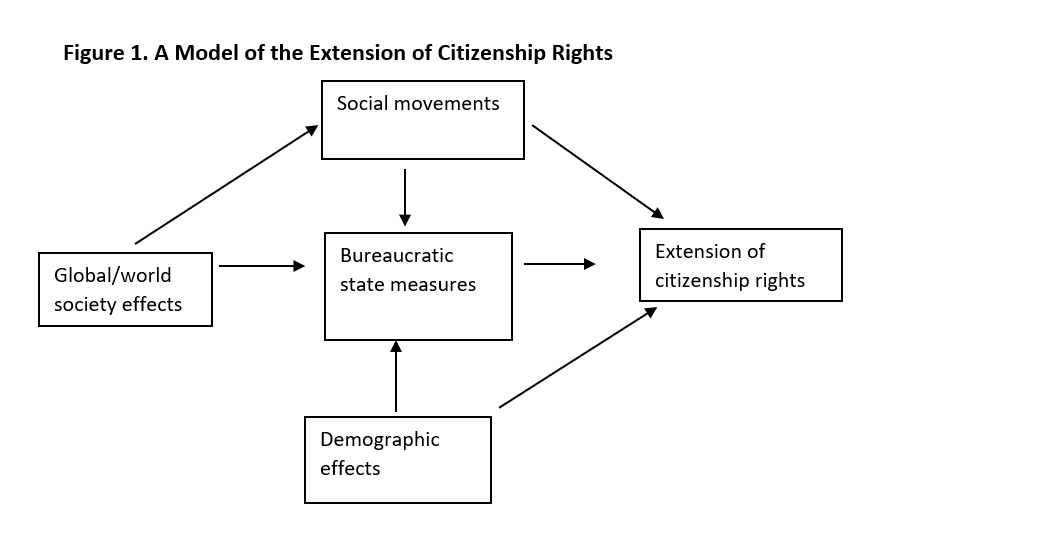
What has tended to be neglected in the literature on citizenship is the salience of international factors. World society/world polity theorists would point to diffusion and implementation processes,(15) and this may be regarded as the positive role of international factors in advancing citizenship rights. In this regard, the UN’s global women’s agenda has been especially influential. (See Figure 1.) However, other international factors may impede, undermine, or reverse gains in women’s citizenship rights. Invasions, occupations, economic sanctions, and debt burdens may result in societal backlashes against women, or shift governmental and societal priorities from rights to security. The 2003 United States (US)/United Kingdom (UK) invasion and occupation of Iraq exemplifies this postulate. Not only did the invasion destabilize the country and lead to a ferocious resistance with countless casualties and much destruction, but many women and girls lost the physical security and autonomy they had previously enjoyed.(16) Two decades later, right-wing Shia Muslim lawmakers began to seek to lower the minimum age of girls’ marriage to nine.(17)
This article builds on existing studies and fills a gap in the literatures on citizenship – feminist and non-feminist alike – through its comparative examination of two MENA region cases of women’s citizenship rights: Tunisia and Iran. Both are Muslim-majority countries, one Arab, the other non-Arab, with republican political systems. The public and private rights of women are very different: Tunisia is a signatory to the UN’s Convention on the Elimination of All Forms of Discrimination against Women (CEDAW) but Iran is not. In both countries, however, women’s citizenship rights and practices are affected by international as well as domestic factors and forces. As such, the paper makes two contributions.
First, it provides an analysis of two divergent cases of women’s citizenship in the MENA region. The two country cases exemplify the variance across the region, in that women’s legal rights are far more advanced and institutionalized in Tunisia than in Iran. The paper delves into the details of each case, showing how women’s citizenship has evolved over time. This includes elucidating the acts of citizenship employed by organized and individual women in both countries and explaining how social and political structures shape those mobilizations and the practice of full citizenship. Women’s capacity to defend or expand their citizenship rights is increased through their ability to build broad-based constituencies, deploy resonant discourses, and develop organizational coalitions.
The article’s second contribution is to demonstrate the salience of international factors in citizenship. As noted, research has established the significance of international oganizations and treaty ratification in enhancing women’s rights to political, social, and economic citizenship; however, the more negative outcomes are under-researched. In Iran’s case, the application of harsh US sanctions over time and the US withdrawal from the 2015 nuclear agreement (the Joint Comprehensive Plan of Action, or JCPOA) have strengthened domestic right-wing forces in Iran and served to impede or reverse progress on women’s participation and rights. Progress was halted on a bill to address violence against women, and the new hardliner president in 2021 called for stricter enforcement of compulsory veiling – which led to the tragic death of Mahsa Jina Amina the following year. In Tunisia’s case, a widely admired democratic transition and emergent gender regime moving in an egalitarian direction was imperilled by the country’s persistent unemployment, high debt burden, and lack of adequate international development cooperation, including foreign direct investment. The ensuing political dysfunction resulted in the presidential coup of June 2021, whereby President Kais Saied assumed vastly greater executive powers. In both Iran and Tunisia, therefore, women’s citizenship rights are subject to both domestic and international factors and forces.
Both Tunisia and Iran experienced a period of ‘state feminism’ in the 1960s and 1970s, although Tunisia started earlier, in 1956, under its first president, French-educated lawyer Habib Bourguiba. Internal dynamics explain much of what occurred, as Mounira Charrad has explained in her comparative study of post-colonial Algeria, Morocco, and Tunisia,(18) but those dynamics were also influenced by developments in world society. One was the demonstration effect of the official policy of women’s equality in the Communist bloc, with women playing a wider array of roles in the economy and polity, along with the launch of state-funded women’s organizations under the umbrella of the Communist-affiliated Women’s International Democratic Federation.(19) Another international influence was the series of international meetings and agreements under the rubric of the UN, starting with the Commission on the Status of Women, launched in 1946, followed by the 1954 Convention on the Political Rights of Women. A third was the emergence of second-wave feminism in Western countries. Such world-society effects paved the way for the UN’s first world conference on women – in Mexico City in 1975 – followed by the Decade for Women (1976-85). They also help explain some of the extraordinary reforms that took place in MENA countries such as Iran and Tunisia in the 1960s and 1970s.
In newly independent Tunisia, three years before the adoption of a constitution, the Code du Statut Personel (CSP) abolished polygamy and gave women the right to divorce.(20) In 1973, married women were given the right to medical abortion in the first trimester. Additional reforms came about in 1993 under the presidency of Zein el-Abedin Ben Ali.(21) Presenting itself as a champion of women’s rights, the Ben Ali regime legalized the two independent feminist organizations that had formed in the 1980s – l’Association tunisienne des femmesdémocrates (ATFD) and l’Association des femmes tunisiennes pour la recherche sur le développement (AFTURD) – and launched a state-funded women’s policy agency, CREDIF. Such organizations were important contributors to Tunisia’s civil society development and growth, which included the large and influential trade union, l'Union général des travailleurs tunisiens (UGTT). Tunisia’s civil society organizations (CSOs) played key roles in the 2011 political revolution and the onset of the democratic transition, which included the drafting of a new constitution, adopted in 2014.
In Iran, modernization and state-building began in the early 20th century after the 1910 Constitutional Revolution, then in the 1930s under Reza Shah.(22) For women, change came about in the early 1960s, when they were granted the right to vote in 1963. A state-affiliated Women’s Organization was created in 1966. The early 1970s saw the appointment of Iran’s first Women’s Affairs minister, the first woman judge, and the first woman ambassador (to Denmark). Family law reform began in 1967 and was expanded in 1975, granting women the right to petition for divorce and child custody and setting 18 as the minimum age of marriage. According to Mahnaz Afkhami, who was briefly Minister for Women’s Affairs, the expansion of the Family Protection Bill in 1975 included abortion decriminalization.(23) Regression in women’s legal status and social positions occurred after the 1979 Islamic Revolution, when the aforementioned law was abrogated and a new constitution and set of family laws within the Civil Code established women’s second-class citizenship. Hejab was made mandatory and the marriage age for girls was lowered to puberty. Article 1130 of the Civil Code was amended in 1982 to give judges the authority to grant or withhold divorces requested by women. Article 1169 of the Civil Code gave custody of the male child to the mother only until the age of two and that of the female child until the age of seven. When a mother remarried, she lost custody. This did not pertain to the father’s remarriage.(24)
Table 1 summarizes the key differences in the two constitutions. As can be seen, Shia Islam – its institutions, norms, and laws – figures prominently in the 1979 Iranian constitutional clauses, which also make women’s rights conditional to ‘Islamic criteria’, as defined by the new religio-political authorities.(25) Tunisia’s 2014 constitution drew to some extent on the 1959 constitution but updated it to include the state’s responsibility to achieve political parity for women and men and to end violence against women.
Despite the restrictions after Islamization, or perhaps because of them, Iranian women began to engage in acts of citizenship, both active and activist. Women members of parliament, especially in the Fifth and Sixth parliaments (1996-2004), collaborated with women’s rights advocates in civil society. Within the political process, they helped effect reforms during the presidency of Hashemi Rafsanjani (1989-97), beginning with a 1992 law that sought to restrain the growing trend of male-initiated divorce by tightening requirements for the registration of divorce and providing women with 12 conditions to petition for divorce. A 1995 decision allowed women to serve as investigative judges, advisors to judges, and advisors within the judiciary, although they still could not make final decisions as judges.(26) Women’s acts of citizenship continued more intensely during the reformist era under President Khatami (1997-2005), during which time civil society expanded. During this period, the women’s caucus of the Sixth parliament was especially active in proposing legislation for women’s rights.(27) In civil society, the ‘One Million Signatures’ and the ‘No to Stoning’ campaigns were launched during this era.(28) Indeed, women’s associations expanded in the 1990s, under both Rafsanjani and especially Khatami, when they began to take on more of an advocacy role. A prominent example was the Markaz-e Farhangi-ye Zanan (Women’s Cultural Center), set up by Noushine Ahmadi-Khorasani, and the Anjoman-e Rooznameh Negaran-e Zan (Association of Women Writers and Journalists) set up by Mahboubeh Abbasgholizadeh. These and other women’s rights groups, and the publications they issued, demonstrated acts of citizenship that were also audacious; as Shekarloo astutely noted at the time, ‘Iranian women take on the Constitution’.(29)
Among the achievements during that reform era, the Sixth parliament passed legislation in 2003 so that the custody of both male and female children was granted to the mother until age seven, after which the family court would decide on custody according to the child’s best interests as well as the child’s own preference. The amended law was now closer to Article 3(1) of the UN’s Convention on the Rights of the Child. Activists within both civil society and political society sought to raise the minimum age of marriage from puberty to 15 but had to accept 13. They also did not succeed in obtaining ratification of CEDAW.(30) More feminist acts of citizenship occurred in 2008-09, such as the outcry over the controversial ‘Family Protection Bill’ under President Mahmoud Ahmadinejad (subsequently withdrawn), and women’s massive participation in the Green Protests, against a second term for Ahmadinejad.
Table 1: Constitutional articles relevant to women’s citizenship
Islamic Republic of Iran (1979) |
Republic of Tunisia (2014) |
Article 1: The form of government of Iran is an Islamic Republic, endorsed by the people of Iran on the basis of their… belief in the sovereignty of truth and Qur'anic justice, …, through the affirmative vote of a majority of 98.2% of eligible voters, held after the victorious Islamic Revolution led by the eminent marji'al-taqlid, Ayatullah al-Uzma Imam Khumayni. |
Article 1. Tunisia is a free, independent, sovereign state; its religion is Islam, its language is Arabic, and its system is republican. This article might not be amended. |
Article 4: All civil, penal financial, economic, administrative, cultural, military, political, and other laws and regulations must be based on Islamic criteria [ahkam and Shia figh]..., the fuqaha' of the Guardian Council are judges in this matter. |
Article 2. Tunisia is a civil state based on citizenship, the will of the people, and the supremacy of law. This article might not be amended. |
Article 19: All people of Iran, whatever the ethnic group or tribe to which they belong, enjoy equal rights; and color, race, language, and the like, do not bestow any privilege.
|
Article 20. International agreements approved and ratified by the Assembly of the Representatives of the People have a status superior to that of laws and inferior to that of the Constitution. |
Article 20: All citizens of the country, both men and women, equally enjoy the protection of the law and enjoy all human, political, economic, social, and cultural rights, in conformity with Islamic criteria.
|
Article 21. All citizens, male and female, have equal rights and duties, and are equal before the law without any discrimination. The state guarantees freedoms and individual and collective rights to all citizens and provides all citizens the conditions for a dignified life. |
Article 21: The government must ensure the rights of women in all respects, in conformity with Islamic criteria, [to]: |
Article 46. The State commits to protecting women’s achieved rights and works to promote and develop them. The State shall guarantee equality of opportunity between men and women in the bearing of all responsibilities and in all fields. The State shall strive to achieve equal representation for women and in elected councils. The State shall take the necessary measures to eradicate violence against women. |
The period after the 2011 political revolution saw feminist mobilization in an effort to ensure that the newly empowered Islamist movement and political party would not undermine women’s achieved rights(31) The defence of the CSP and the 1959 constitution became one of the most significant debates during the drafting of Tunisia’s 2014 constitution, especially after Islamists sought to replace references to the equality of women and men with their complementarity.(32) That battle was won, along with the inclusion of an article on defending women from violence (as in Table 1); additional victories included lifting Tunisia’s remaining reservations to CEDAW. At the time, it appeared that the struggle for women’s citoyennité had been won.
In other notable achievements, a state-funded women’s shelter was built in Ben Arous; women candidates won 31% of seats in the October 2014 parliamentary elections; the strongest law to date on violence against women was adopted in July 2017, which also removed the ability of a rapist to avoid prosecution if he married his victim; the 1973 law prohibiting a Muslim Tunisian woman from marrying a non-Muslim man was abrogated in September 2017; and the May 2018 municipal assembly elections saw women candidates secure 48% of seats. In August 2017, President Essebsi named Bochra Bel Haj Hmida—lawyer, long-standing ATFD member, and member of parliament—as chair of the Committee on Individual Liberties and Rights, known by its French acronym, COLIBE. The nine-person commission was tasked with preparing a report on harmonizing Tunisian law with the international agreements to which Tunisia was a party. One of the recommendations pertained to equal inheritance rights for women.(33)
At the time, Facebook group postings by Tunisian feminists showed satisfaction with the recent overturning of the 1973 law banning Tunisian women from marrying non-Muslim men, and they were hopeful that family inheritance would finally be made equal. In 2018, Iqbal Gharbi, a feminist lawyer and one of the four female members of COLIBE, proudly posted photos and updates to the Facebook group, including information on the new bill for equal inheritance that was soon to be debated in parliament.(34)
Tunisia’s movement to defend and expand women’s citizenship rights began on a more propitious political terrain than was the case in Iran. Not only did Tunisia’s democratic transition favour women’s rights, but civil society had always been far stronger in Tunisia than in Iran. As a result, the 2014 women-friendly constitution provided a legal and normative foundation for a rights-based political culture. In turn, the institutional legacy of the Ben Ali and Bourguiba eras, along with the new democratic environment, enabled a stronger presence of women in the political process and across occupations and professions, and set the stage for the COLIBE commission. As research shows, constitutional guarantees of women’s equality are not sufficient but they are a necessary condition for women’s rights of citizenship.(35) The World Economic Forum’s Global Gender Gap Report 2018 ranked Tunisia a high of 55 on political empowerment, while Iran was ranked a very low 141.(36) An examination of the World Bank’s Women, Business and the Law database showed many more legal restrictions in Iran than in Tunisia.(37) Such legal restrictions have undermined Iranian women’s political inclusion and equal citizenship, especially when compared with Tunisia, as seen in Table 2.
And yet, both Tunisia and Iran suffered from an international environment that adversely affected women’s ability to retain or expand their rights to citizenship.
As noted in the introduction, citizenship is a concept rooted in the national body politic and its related institutions and relations, as well as in the forms of participation, activism, and claims-making that are possible. That is, both citizenship regimes and acts of citizenship are influenced by domestic dynamics, and the above sections examined those dynamics, comparing legal frameworks and other institutions in Iran and Tunisia and the possibilities or constraints they have posed for women’s participation and rights. Here we turn attention to the international factors and forces that have impinged on women’s citizenship rights in Iran and Tunisia, whether directly or indirectly.
We start with Tunisia, which saw a series of political, security, and economic challenges that adversely affected its post-2011 democratic transition. Despite its reputation as one of the more liberal countries in the Arab world and the region’s only democratic success story, several regional and international developments combined to make Tunisia a fertile recruiting ground for the so-called Islamic State of Iraq and Syria (ISIS). These included Tunisia’s legacy of uneven development and deprivation in interior regions, its insecure borders following the 2011 NATO attack on neighboring Libya, and the onset of an internationalized civil conflict in Syria, along with declining foreign direct investment and receipts from tourism. In response, the Tunisian government sharply increased defense and security spending.(38)
Table 2. Comparative Female Labor Force and Related Indicators, Iran and Tunisia, 2021 (or most recent year)
|
Iran 2021 |
Tunisia 2021 |
||
Total Labour Force (M&F) |
23.4 million |
% |
3.4 million |
% |
Total Female Labour Force |
3.7 million |
15.8% |
885,500 |
29.5% |
employees |
2.2 million |
60.2% |
779,800 |
88% |
employers |
33,500 |
0.9% |
18,300 |
2.1% |
own-account workers |
857,400 |
23.15% |
60,500 |
6.8% |
contributing family workers |
582,400 |
15.7% |
26,900 |
3.1% |
Unemployment rate (F) |
|
36% 15-24 13.6% 25+ (2020) |
|
37.2% 15-24 (2017) 22.2% 25+ (2010) |
Sustainable Development Goals (SDG) indicators |
|
|
|
|
Proportion women above retirement age receiving a pension |
|
2.6% (2020) |
|
n.a. |
Unemployed receiving unemployment benefits (F) |
|
5.4% (2020) |
|
17.3% (2020) |
Mothers with newborns receiving maternity benefits |
|
13.1% (2020) |
|
25.3 % (2020) |
Proportion of women in senior and management positions / |
|
18.7% (2020)*/ 18% (2020)** |
|
19.3% (2010) 15% (2012) |
Parliamentary representation (% F)*** |
|
5.6% |
|
26% |
Source: ILOSTAT Explorer (accessed 19 February 2022)
Notes: *7.4% in 2010; **14.6% in 2010; ***IPU data
Tunisia’s total labour force participation rate remained low (51.7%), particularly among women (28.2%). Unemployment became more pronounced among women, youth, and low-income groups. Whereas total unemployment stood at 15% in mid-2017, it was highest among youth (35.7%), women (21.5%), and university graduates (39.5%, with women at 40%).(39) High unemployment rates were found in the interior regions of the southeast and southwest, which also experienced poverty and deteriorating social services and physical infrastructure. Sadiki refers to the ‘multiple marginalizations’ present in such regions, which led to frequent protests.(40)
After 2011, successive governments increased social spending and public sector hiring to cope with the rising social unrest and youth unemployment; but this was carried out through loans from the International Monetary Fund (IMF) that came to burden the country. The IMF continued to monitor Tunisia for currency devaluation, containment of the public sector wage bill (through retirement packages and wage and hiring freezes), ‘flexibility’ with the minimum wage, recapitalizing the banks, and ‘strengthening the Central Bank’s independence’.(41) The powerful trade union UGTT compelled the government to approve salary increases in 2018, but these were offset by inflation. Protests and strikes in the country’s interior, where residents demanded more employment and investment, paralyzed gas, petroleum, and phosphate production. Most of Tunisia’s debt was external debt. In July 2020, with a shrinking economy but more spending to offset the effects of the COVID-19 pandemic, the government sought to delay debt repayment to Saudi Arabia, Qatar, France, and Italy.(42)
Tunisia’s public-debt-to-GDP ratio increased from about 40% in 2010-2011 to 77% at the end of 2018.(43) In 2022, it was perhaps as high as 95 percent. The 2021 OECD report highlighted problems associated with the budget deficit, debt, and the pandemic. A study of Tunisia’s economic woes reiterated calls for more European assistance to bolster Tunisia’s economy and help consolidate its democratic transition.(44) Instead of loans, Tunisia needed investments and growth in sectors such as manufacturing, finance, communications, tourism, and food processing. Another study asserted that the new democratic system had ‘so far failed to satisfy peoples’ hopes for improved living standards. In fact, it has presided over their deterioration.’(45) In June 2020, healthcare workers went on strike to protest cutbacks and reduced salaries and to demand better working conditions.(46)
In the midst of the economic crisis and political dysfunction, women continued to engage in acts of citizenship. In March 2018, the Tunisian Coalition for Equality in Inheritance, composed of some 70 women's rights groups, mobilized hundreds of protesters in front of the parliament to support the COLIBE report and call for a law guaranteeing equal family inheritance rights for women. After the death of then-president Beji Essebsi, his successor, Kais Saied, indicated his lack of support for the equal inheritance bill and it was shelved. In August 2021, a feminist leader, Sana Ben Achour, issued a scathing critique of the president’s populist politics and his opposition to equal inheritance, distributed via Facebook.(47)
The reversals that Tunisia saw after President Saied’s draconian intervention in the summer of 2021 – in both the quality of its democracy and its gendered citizenship regime – can only be understood by examining the presence or absence of international economic and financial solidarity and support as well as domestic institutions and relations. For example, in the decade following Tunisia’s 2011 political revolution, the European Union provided some €3 billion in economic assistance: over €2 billion in grants and €1.1 billion in macro-financial assistance (concessional loans).(48) In contrast, the EU paid out €4.1bn to Ukraine in the first five months after the outbreak of war with Russia, ‘to support Ukraine’s macro-financial stability and the functioning of its public administration’, and more loans were provided in 2023.(49) In September 2024, EU Commission president Ursula von der Leyen approved an additional €35 billion loan from the EU.(50) Meanwhile, Tunisia’s government received funds from the EU primarily to prevent African migrants from reaching European shores.(51)
Turning now to Iran, I have noted the significant institutional differences with Tunisia, such as the presence of vastly more discriminatory legal frameworks, and the marginal position of Iranian women in political representation. Those restrictions, however, have tended to intensify in tandem with US pressures: during the presidency of Mahmoud Ahmadinejad (2005-13), when the US under the Obama government increased sanctions on Iran for its uranium enrichment program, and after the 2018 unilateral withdrawal from the Iran nuclear agreement (JCPOA) by the Trump government and its application of ‘maximum pressure’ sanctions. A 2021 report by the UN Special Rapporteur on Human Rights raised concerns that sanctions had hindered Iran’s response to COVID-19. The Rapporteur repeated calls by the Secretary-General and High Commissioner for Human Rights for States to at least ease sanctions in support of the fight against COVID-19.(52)
Despite Iran’s high healthcare spending, sanctions have adversely affected medical education, clinical training, and international exchanges as well as cancer care.(53) Medical researchers write that ‘Iran’s inability to export oil … resulted in a reduction in the country’s research budget’, including research and treatment for COVID-19.(54) As Salehi-Isfahani wrote: ‘Rather than easing sanctions to help Iran manage the pandemic better, … the US piled on more sanctions.’(55) Lack of access to financial markets and shortage of foreign exchange worsened Iran’s health crisis, and many healthcare workers – including the many women who work in the healthcare sector – lost their lives to the pandemic. US secondary sanctions prevented Iran from accessing its foreign exchange reserves held in foreign banks to buy medical supplies or import other essential goods. Some USD 100 billion of Iran’s money remained frozen in overseas banks, including USD 10 billion held in the US.(56) Iran’s request of USD 5 billion from the IMF – its first loan request since the 1960s – was opposed by the US.(57) COVID-19 hit Iran hard, and many Iranian citizens came to blame the regime for mismanaging the pandemic and the economy.
The intensity of US sanctions on Iran and their effects has included price distortions, a decline in real expenditures of households, growing poverty, and rising income inequality. Indeed, Iran’s poverty rate rose from 10.7% in 2013 to 17.8% in 2019. According to a World Bank report, up until 2010, Iran had ‘achieved remarkable progress in terms of poverty reduction and human development’, but between 2011 and 2020, the share of Iranians living below the international poverty line increased from 20% to 28.1%.(58) Following a 50% fuel price hike, protests broke out in 2018-2019 but were harshly repressed.
Sanctions have affected Iranian women’s labour force participation, which was low to begin with. The onset of austerities that accompanied the sanctions pressures led to a steady decline in Iranian women’s labour-force participation from a high of 19.5% in 2005 to 15.8% in 2021. Moghaddasi-Kelishomi and Nisticò found that 17,731 new jobs would have been created between 2012-2014 had the 2012 sanctions not occurred.(59) Laudati and Pesaran note that secondary schooling took a hit, with ‘statistically significant negative effects on the ratio of female-to-male students’. They conjecture that government responses to sanctions-induced reductions in oil income were accompanied by ‘budgetary allocations away from education and female participation’.(60) Demir and Tabrizy add that ‘sanctions hurt female employment significantly more than male employment’, particularly ‘in industries with relatively high reliance on imported inputs’. (61)
Sanctions, austerities, and the healthcare crisis, combined with Iran’s falling birthrate, led to the introduction in late 2021 of a bill called ‘Rejuvenation of the Population and Support of Family’.(62) On the positive side, the bill would provide various benefits to people with children, including increased employment benefits for pregnant women and those who breastfeed. It would prohibit firing or transferring a working woman during pregnancy against her will (although it does not prohibit discrimination in hiring practices). Article 17 would provide for nine months of fully paid maternity leave in all sectors, an option for working from home for up to four months during pregnancy, and an option to take leave for medical appointments for women with children under age seven. On the other hand, according to an assessment by Human Rights Watch, the bill would place limits on access to contraception and abortion and would remain in effect for seven years. Under the previous law, abortion could be legally performed during the first four months of pregnancy if three doctors agreed that a pregnancy threatened a woman’s life or if the foetus had severe physical or mental disabilities that would create extreme hardship for the mother. But the bill’s Article 59 would require the Intelligence Ministry and other security agencies to identify and refer to judicial authorities any cases of ‘illegal sale of abortion drugs, illegal abortion, websites gathering the list of abortion centers, those participating in illegal abortion, and medical advice outside the permission criteria for abortion, and elements advocating for illegal abortion’. And it would require the relevant ministries to produce pro-family materials and to increase education majors at universities ‘consistent with women’s role in the Islamic-Iranian culture including managing family and the house’.(63)
Since at least the Sixth parliament (1997-2005), efforts to finalize a bill on domestic violence have encountered obstacles and delays. The 2021 Rehman report highlighted serious concerns regarding domestic violence. Some positive steps were noted, such as a law against acid attacks, but the Special Rapporteur pressed the Iranian Government to do more:
Blatant discrimination exists in Iranian law and practice that must change. In several areas of their lives, including in marriage, divorce, employment, and culture, Iranian women are either restricted or need permission from their husbands or paternal guardians, depriving them of their autonomy and human dignity. These constructs are completely unacceptable and must be reformed now.(64)
A watered-down version of the original bill was adopted by parliament in April 2023 but at the time of writing, it had not yet received the final approval from the Council of Guardians.
In 2021, elections for a new president brought to power Ebrahim Raissi, a hardliner who had been involved in the mass executions of political prisoners in summer 1988. Among his first acts after assuming the presidency was to call for stricter enforcement of mandatory hejab. This is what led to the arrest and death in police custody of Mahsa Jina Amini in mid-September 2022, and the nationwide protests that lasted into the new year and beyond.
This article has provided a comparative perspective on two MENA countries, Iran and Tunisia, to highlight the salience of both international and domestic factors and forces in the construction and enjoyment of women’s political, social, and economic rights of citizenship. On the domestic front, legal frameworks matter, and discriminatory family laws curtail women’s rights. Family law in MENA countries affects women’s civil, political, and social/economic rights of citizenship through provisions that favour men in guardianship, family headship and maintenance, the mahr, and inheritance. Unequal family inheritance puts female kin at a disadvantage in terms of wealth acquisition and assets that could be used for business development. Iran is economically richer and larger than Tunisia, but women’s economic empowerment is constrained in both countries, and both states codify unequal inheritance. Women’s unequal inheritance rights are surely one important explanation behind low female labor force participation in the MENA region.
Tunisia and Iran diverge significantly on women’s public and private rights – rights within the family and women’s political presence as activists and members of parliament – and on women’s legal status and constitutionally defined citizenship equality. Such divergence results from differences in political history, the strength of civil society, and institutionalization processes. Constitutional guarantees of women’s equality are not sufficient, but they are necessary for women’s rights of citizenship, and the differences in constitutional language in Iran and Tunisia correlate with differences in political participation, and to some degree in women’s economic citizenship. Still, both countries have seen vocal and visible acts of citizenship. In Tunisia, women took to the streets in 2011 to ensure that their achieved rights were not endangered, and they have criticized the suspension of rights since 2021, as well as the replacement of the 2014 constitution with a new, less celebrated constitution. In Iran, given women’s continued exclusion from political power, they invent new spaces to participate politically, and new acts of citizenship, such as defying the mandatory dress code in public and on social media platforms, and taking part in or leading protests.
On the international front, institutions and state practices affect women’s citizenship in both positive and negative ways. On the positive side, the diffusion of international conventions and norms – CEDAW, the gender equality objectives of international agreements such as the Sustainable Development Goals, the ranking of countries on women’s political and economic empowerment by the World Economic Forum’s annual Global Gender Gap Report, and human rights reports by the UN – provide a legal and normative framework for advocacy work by civil society actors and for the adoption of policies and laws at the state level. On the negative side, invasions, wars, sanctions, debt, and lack of cooperation for democratic development have deleterious effects on human security, human rights, and women’s equality, rights, and economic empowerment. At the worst, they cause deaths, displacement, and outmigration. Such international incursions or neglect can also generate uncertainties, instabilities, repression, and patriarchal backlashes.(65)
The two cases offer lessons and raise questions with broader applications pertaining to citizenship rights, women’s legal status, and the world order. Tunisia’s misfortune was that its political revolution and democratic transition occurred during the post-2008 Great Recession and a decade before a global pandemic followed by the Western focus on – and financial generosity toward – the war in Ukraine. If Tunisia’s democratic transition and consolidation have been blocked since at least 2021, what are the prospects for advances in women’s equal citizenship? In Iran, President Masoud Pezeshkian, elected in July 2024, nominated four women to top government positions, including the cabinet post of minister of urban development, and some were hopeful that more such changes would be forthcoming. However, if the US persists with its harsh sanctions against Iran, which harm women in specific ways, what internal or international opportunities are available for the achievement of women’s equal citizenship and empowerment?
I end with some recommendations. For the women and girls of Iran and Tunisia to advance and attain equality of citizenship and the enjoyment of political, civil, and social/economic rights, both domestic and international changes are needed. Domestically, both countries must adopt legislation ensuring women’s equal rights to inheritance. In Iran, hejab should be voluntary; the state must raise the minimum age at first marriage to 16, ban child marriage, and ratify CEDAW. Internationally, the sanctions regime against Iran must end and Tunisia’s debt be cancelled. International actors should provide the needed economic cooperation that would lower the unemployment rate in both countries, with a view toward more employment opportunities for women. Acts of citizenship will continue in both countries, but those can be supported through constructive – rather than destructive – international measures.
* Professor of Sociology and International Affairs, Northeastern University, USA. Email v.moghadam@northeastern.edu
(1) TH Marshall and T Bottomore, Citizenship and Social Class (CUP, Cambridge, 1992), 6, 8-10. Marshall’s book was first published in 1950. It traced the evolution of rights in Britain and the conceptual foundations of a welfare state there but has inspired many subsequent scholars.
(2) On varied citizenship regimes, see T Janoski, Citizenship and Civil Society: A Framework of Rights and Obligations in Liberal, Traditional, and Social Democratic Regimes (CUP, Cambridge, 1998).
(3) B Turner, ‘Outline of a Theory of Citizenship’ [1990], Sociology 24(2), 189-217; EF Isin and GM Nielsen, ‘Introduction’, in Isin and Nielsen (eds.), Acts of Citizenship (Zed Books, London, 2008), 1-12.
(4) C Pateman, The Sexual Contract (Stanford UP, Stanford, 1988). See also: R Lister, Citizenship: Feminist Perspectives (Palgrave, London, 1997), and ‘Dilemmas in Engendering Citizenship’, in B Hobson (ed), Gender and Citizenship in Transition (Routledge, London, 2000); U Narayan, ‘Towards a Feminist Vision of Citizenship: Rethinking the Implications of Dignity, Political Participation, and Nationality’, in M Lyndon Shanley and U Narayan (eds), Reconstructing Political Theory: Feminist Perspectives (Polity, London, 1997); S Walby, ‘Is Citizenship Gendered?’ [1994], Sociology 28(2), 379-395.
(5) N Berkovitch, From Motherhood to Citizenship: Women’s Rights and International Organizations (JHU Press, Baltimore, 1999); M Keck and K Sikkink, Activists Beyond Borders: Advocacy Networks in International Politics (Cornell UP, Ithaca, 1998); P Paxton, M Hughes and T Barnes, Women, Politics, and Power (4th edn, Rowman & Littlefield, Lanham, 2020).
(6) In Iran, for example, a non-Muslim citizen (Christian, Jewish, Zoroastrian) cannot attain a high government position, such as cabinet minister. This is not the case for Christians in Jordan or Egypt, but in the latter, attacks on Christian (Coptic) gatherings have occurred with some frequency, and church construction, unlike the building of mosques, is limited. See, e.g., Heba Habib, ‘Palm Sunday church attacks: Egypt’s “worse day of violence”’, Al-Jazeera, 8 April 2022, https://www.aljazeera.com/news/2022/4/8/palm-sunday-church-attacks-egypts-worst-day-of-violence.
(7) The rich literature on Islamic feminism includes: A Barlas, Believing Women in Islam: Unreading Patriarchal Interpretations of the Qur’an (University of Texas Press, Austin, 2002); Z Anwar, ‘Introduction: Why Equality and Justice Now’, in Anwar (ed), Wanted: Equality and Justice in the Muslim Family (Musawah [an initiative of Sisters in Islam], Malaysia, 2009), 1–11; A Lambaret, Women and Men in the Qur’an (Palgrave Macmillan, Cham, 2018); F Mernissi, The Veil and The Male Elite: A Feminist Interpretation of Women’s Rights in Islam (Perseus Books Publishing, Canada, 1991); Z Mir-Hosseini, Islam and Gender: The Religious Debate in Contemporary Iran (Princeton UP, London and New York, 1999).
(8) On these matters, see Islam Online, ‘Rights and Duties of the Wife and the Husband’, https://fiqh.islamonline.net/en/rights-duties-of-the-wife-and-the-husband/. It is worth noting that such marital duties and privileges have been present under many legal and customary systems across history and the globe. For a cross-national survey on contemporary applications of Islamic law, see A An-Naim, Islamic Law in a Changing World: A Global Resource Book (Zed Books, London, 2002).
(9) VM Moghadam, ‘Gender Regimes in the Middle East and North Africa: The Power of Feminist Movements’ [2020], Social Politics 27(3), 467–485. The concept originates with H Sharabi, Neopatriarchy: A Theory of Distorted Change in Arab Society (Oxford UP, New York, 1988).
(10) M Charrad, States and Women’s Rights: The Making of Postcolonial Tunisia, Algeria, and Morocco (University of California Press, Berkeley, 2001); S Joseph (ed), Gender and Citizenship in the Middle East (Syracuse UP, Syracuse, 2000); VM Moghadam, ‘Engendering Citizenship, Feminizing Civil Society: The Case of the Middle East and North Africa’ [2003], Women & Politics 25(1-2), 63-87.
(11) VM Moghadam, Modernizing Women: Gender and Social Change in the Middle East (2nd edn, Lynne Rienner Publishers, Boulder and London, 2003), and ‘Gender Regimes, Polities, and the World-System: Comparing Iran and Tunisia’ [2023], Women’s Studies International Forum 98(3), 102721.
(12) S El Yaaqoubi, ‘How is Morocco Navigating Backlash to Family Law Reform?’, Enheduanna, A blog of the Middle East Women’s Initiative (Wilson Center, Washington DC, 11 July 2024), https://www.wilsoncenter.org/blog-post/how-morocco-navigating-backlash-family-law-reform,
(13) R Maktabi, ‘Family Law, Female Citizenship, and State Formation in Arab States: Pre-2011 Conditions and Post-2011 Reflections on Political Transitions’, in H Rydving and S Olsson (eds), Religion, Law, and Justice: Seven Essays (Novus Forlag, Oslo, 2018), and ‘Patriarchal Nationality Laws and Female Citizenship in the Middle East’, in R Meijer, JN Sater, and ZR Babar (eds), Routledge Handbook of Citizenship in the Middle East and North Africa (Routledge, London, 2021); M Tajali, ‘Islamic Women’s Groups and the Quest for Political Representation in Turkey and Iran’ [2015], Middle East Journal 69(4), 563-581; A Tripp, Seeking Legitimacy: Why Arab Autocracies Adopt Women’s Rights (CUP, Cambridge, 2019).
(14) G Turkarslan, Engendering Citizenship: Women’s Movements in Tunisia and Turkey (Ph.D. diss., Koc University, Turkey, 2019).
(15) See n 5; see also VM Moghadam, ‘Advocacy, Activism, and Resistance’, in LJ Shepherd and C Hamilton (eds), Gender Matters in Global Politics (3rd edn, Routledge, London, 2022).
(16) On the consequences of the US/UK invasion, see N Al-Ali and N Pratt, What Kind of Liberation? Women and the Occupation of Iraq (University of California Press, Berkeley, 2010).
(17) Z Al Mahsat and O Al Jaffal, ‘Draft Iraqi law allowing 9-year-olds to marry would “legalize child rape”, say activists’, The Guardian, 9 August 2024, https://www.theguardian.com/global-development/article/2024/aug/09/proposed-iraqi-law-change-would-legalise-child-say-activists.
(18) Charrad, above n 10.
(19) E Armstrong, ‘Before Bandung: The Anti-Imperialist Women's Movement in Asia and the Women's International Democratic Federation’ [2016], Signs 41(22), 305-331; F de Haan, ‘Continuing Cold War Paradigms in Western Historiography of Transnational Women’s Organisations: The Case of the Women’s International Democratic Federation (WIDF)’ [2010], Women’s History Review, 19(4), 547-573.
(20) M Charrad, ‘Policy Shifts: State, Islam, and Gender in Tunisia, 1930s-1990s’ [1997], Social Politics, 4(2), 284-319; J Tchaicha and K Arfaoui, The Tunisian Women’s Rights Movement: From Nascent Activism to Influential Power-Broking (Routledge, London, 2017).
(21) L Labidi, ‘The Nature of Transnational Alliances in Women’s Associations in the Maghreb: The Case of AFTURD and ATFD in Tunisia’ [2007], Journal of Middle East Women’s Studies, 3(1), 6-34.
(22) E Sanasarian, The Women’s Rights Movement in Iran: Mutiny, Appeasement, and Repression from 1900 to Khomeini (Praeger, New York, 1982); H Sedghi, Women and Politics in Iran: Veiling, Unveiling, and Reveiling (CUP, Cambridge, 2007).
(23) M Afkhami, The Other Side of Silence (University of North Carolina Press, Durham, 2022), and ‘Iran: A Future in the Past – The “Prerevolutionary” Women’s Movement,’ in Robin Morgan (ed), Sisterhood is Global (Anchor Books, New York, 1984), 330-338. See also J Afary, Sexual Politics in Modern Iran (CUP, Cambridge, 2009) and The Iranian Constitutional Revolution 1906-1911: Grassroots Democracy and the Origins of Feminism (Columbia UP, New York, 1996).
(24) M Kar, ‘Women and Personal Status Law in Iran: An Interview with Mehrangiz Kar’ [1996], Middle East Report 198, 36-38. See also M Boe, Family Law in Contemporary Iran: Women’s Rights Activism and Sharia (IB Tauris, London, 2015).
(25) H Hoodfar, ‘Iranian Women at the Intersection of Citizenship and the Family Code: The Perils of Islamic Criteria’, in S Joseph (ed), Gender and Citizenship in the Middle East (Syracuse UP, Syracuse, 2000), 287-313.
(26) M Kar and A Pourzand, ‘Iran’, in M Afkhami, Y Erturk, and A E Mayer (eds), Feminist Advocacy, Family Law, and Violence Against Women: International Perspectives (Routledge, London, 2019), 84-85; Moghadam, above n 11, 193-226.
(27) Boe, above n 24; VM Moghadam and F Haghighatjoo, ‘Women and Political Leadership in an Authoritarian Context: A Case Study of the Sixth Parliament in the Islamic Republic of Iran’ [2016], Politics & Gender, 12, 168-197.
(28) Iran’s One Million Signatures campaign, inspired by the Moroccan campaign of the early 1990s, sought to acquire support for reform of the discriminatory measures in the family law and constitution. Post-revoutionary Islamization had emboldened some local authorities to prosecute adultery with public stonings, especially in rural areas, and the No Stonings campaign sought to highlight the practice and help put an end to it. Details of this era and the campaigns are found in: A Osanloo, The Politics of Women’s Rights in Iran (Princeton UP, Princeton, 2009); P Paidar, Women and the Political Process in Twentieth-Century Iran (CUP, Cambridge, 2001);C Sameh, Axis of Hope: Iranian Women’s Activism across Borders (University of Washington Press, Seattle, 2019); N Shahrokni, Women in Place: The Politics of Gender Segregation in Iran (University of California Press, Oakland, 2019).
(29) M Shekarloo, ‘Iranian Women Take on the Constitution’ [2005] MERIP, https://merip.org/2005/07/iranian-women-take-on-the-constitution/
(30) VM Moghadam and F Haghighatjoo, above n 27.
(31) MM Charrad and A Zarrugh, ‘The Arab Spring and Women’s Rights in Tunisia’ [2013], E-International Relations, http://www.e-ir.info/2013/09/04/the-arab-spring-and-womens-rights-in-tunisia/; A Khalil, ‘Tunisia’s Women: Partners in Revolution’ [2014], Journal of North African Studies, 19(2), 186–199; K Arfaoui and VM Moghadam, ‘Violence against Women and Tunisian Feminism: Advocacy, Policy, and Politics in an Arab Context’ [2016], Current Sociology 64(44), 637-653.
(32) MM Charrad and A Zarrugh, ‘Equal or Complementary? Women in the New Tunisian Constitution After the Arab Spring’ [2014], The Journal of North African Studies, 19(2), 230-243.
(33) VM Moghadam, ‘Institutions, Feminist Mobilizations, and Political Economy: Debating Equal Inheritance in Tunisia’ [2022], British Journal of Middle East Studies, 51(3), 451-468.
(34) I was a recipient of those Facebook postings, and remain so.
(35) S Austin and A Mavisakalyan, ‘Constitutions and the Political Agency of Women: A Cross-Country Study’ [2016], Feminist Economics, 22(1), 183-210.
(36) World Economic Forum, Global Gender Gap Report 2018 (WEF, Geneva 2018), 18. That year, countries in the top 10 for women’s political empowerment included Iceland, Sweden, Norway, Finland, and France, but also Nicaragua and Rwanda. At 55, Tunisia was just below Estonia, Portugal, and Uruguay – an impressive ranking for a MENA country – and much higher than the US ranking of 98.
(37) The WBL index captures mobility, workplace, pay, marriage, parenthood, entrepreneurship, assets, pensions. For details on conceptualization and measurement, see Table 2.1 in the 2020 Report: https://openknowledge.worldbank.org/bitstream/handle/10986/32639/9781464815324.pdf
(38) S Mako and VM Moghadam, After the Arab Uprisings: Progress and Stagnation in the Middle East and North Africa (CUP, Cambridge, 2021), 199-200.
(40) L Sadiki, ‘Regional Development in Tunisia: The Consequences of Multiple Marginalization’ [2019], Brookings Doha Center 202, https://www.brookings.edu/wp-content/uploads/2019/01/Regional-development-in-Tunisia-the-consequences-of-multiple-marginalization_English-Web.pdf.
(41) F Aliriza, ‘Perpetual Periphery: IFIs and the Reproduction of Tunisia’s Economic Dependence’, in T Radwan (ed), The Impact and Influence of International Financial Institutions on the Economies of the Middle East and North Africa (Friedrich Ebert Stiftung Regional Project, Tunis, 2020), 37-38.
(42) Reuters, ‘Tunisia seeks late debt payments as crisis hits economy: state budget’ (13 July 13, 2020), https://www.reuters.com/article/business/finance/tunisia-seeks-late-debt-payments-as-crisis-hits-economy-state-budget-idUSKCN24E18V/.
(43) Aliriza, above n 41, 35-36.
(44) T Megerisi, ‘Back from the Brink: A Better Way for Europe to Support Tunisia’s Democratic Transition’ [2021], European Council on Foreign Relations Policy Brief 403.
(45) R Weilandt, ‘Socio-economic Challenges to Tunisia’s Democratic Transition’ [2018], European View 17(2), 217.
(46) Personal communication from a UGTT health sector official; see also AFP, ‘Tunisian Healthcare Workers Strike to Demand Reforms’, Mail Online (18 June 2020), https://www.dailymail.co.uk/wires/afp/article-8437151/Tunisian-healthcare-workers-strike-demand-reforms.html.
(47) Details are in Moghadam, above n 33.
(48) European Commission, ‘Tunisia: Latest News’, https://ec.europa.eu/neighbourhood-enlargement/european-neighbourhood-policy/countries-region/tunisia_en.
(49) See European Commission, ‘EU Solidarity with Ukraine – Timeline’: https://commission.europa.eu/topics/eu-solidarity-ukraine/eu-solidarity-ukraine-timeline_en.
(50)C Koromi and G Sorgi, ‘Von der Leyen announces €35B EU loan for Ukraine’, Politico (20 September 2024), https://www.politico.eu/article/ursula-von-der-leyen-announce-e35-billion-eu-loan-ukraine/.
(51) L O’Carroll, ‘EU may give Tunisia more than 1bn euros in aid to help finances and stem migration’, The Guardian (11 June 2023),https://www.theguardian.com/world/2023/jun/11/tunisia-president-kais-saied-migration-europe-border-guard-comments-imf-bailout.
(52) J Rehman, ‘Situation of Human Rights in the Islamic Republic of Iran: Report of the Special Rapporteur on the Situation of Human Rights in the Islamic Republic of Iran, Javaid Rehman’, UN Human Rights Council (2021), https://digitallibrary.un.org/record/3899852?v=pdf.
(53) The sentence draws on M Aloosh, ‘How Economic Sanctions Compromise Cancer Care in Iran’ [2018], The Lancet, 19(7); O Behrouzan and T Sepehri Far ‘Iran Under Sanctions: The Impact of Sanctions on Medical Education in Iran’ [2020], SAIS reports on Rethinking Iran, https://www.rethinkingiran.com/iran-under-sanctions; K Harris, ‘Iran Under Sanctions: Iran’s Government Expenditure Priorities and Social Policy Burdens During Sanctions’ [2020], SAIS reports on Rethinking Iran: Iran Under Sanctions, https://www.rethinkingiran.com/iran-under-sanctions.
(54) Z Hemati, S Jahanfar, and M Keikha, ‘COVID-19, Sanctions, and Importance of Scientometric and Systematic Review Studies in Iran’, International Journal of Preventative Medicine [2022], 13, 127; see also A Abdoli, ‘Iran, Sanctions, and the COVID-19 Crisis’, Journal of Medical Economics [2020], 23(12), 1461–1465.
(55) D Salehi-Isfahani, ‘Iran: The Double Jeopardy of Sanctions and COVID-19’, Brookings Op-ed (23 September 2020), https://www.brookings.edu/opinions/iran-the-double-jeopardy-of-sanctions-and-covid-19/; see also Abdoli, ibid.
(56) E Batmanghelidj, ‘Explainer: Iran’s Frozen Assets’, United States Institute of Peace: The Iran Primer (1 November 2021): https://iranprimer.usip.org/index.php/blog/2021/nov/01/explainer-iran%E2%80%99s-frozen-assets.
(57) I Talley, ‘U.S. to block Iran’s request to IMF for $5 billion loan to fight coronavirus’, Wall Street Journal (7 April 2020): https://www.wsj.com/articles/u-s-to-block-irans-request-to-imf-for-5-billion-loan-to-fight-coronavirus-11586301732.
(58) World Bank, ‘Iranian Poverty Diagnostic: Poverty and Shared Prosperity’, The World Bank (November 2023) 14. See also ‘Iran Poverty Rate 1986-2024’, macrotrends: https://www.macrotrends.net/countries/IRN/iran/poverty-rate.
(59) A Moghaddasi-Kelishomi and R Nisticò, ‘Employment Effects of Economic Sanctions in Iran’ [October 2021], Discussion Paper Series: Institute of Labour Economics (IZA DR No. 14814).
(60) D Laudati and MH Pesaran, ‘Identifying the Effects of Sanctions on the Iranian Economy Using Newspaper Coverage’ [August 2021], CESifo Working Paper no. 9217.
(61) F Demir and S Tabrizy, ‘Gendered Effects of Sanctions on Manufacturing Employment: Evidence from Iran’ [2022], Review of Development Economics, 26(4), 1-30. See also M Karshenas and VM Moghadam, 'What Explains Iran’s Low Female Labor Force Participation? Examining Institutions, Wages, and Sanctions' [Dec 2024], Sociology of Development, 10(4), 401-31.
(62) Human Rights Watch, ‘Iran: Population Law Violates Women’s Rights’ (10 November 2021), https://www.hrw.org/news/2021/11/10/iran-population-law-violates-womens-rights.
(63) Ibid.
(64) Rehman, above n 52, 14.
(65) See VM Moghadam, ‘The Gendered Politics of Iran-US Relations: Sanctions, the JCPOA, and Women’s Security’ [2024], Third World Quarterly, 45(7), 1199-1218.