Donna Haraway undertakes the task of reappropriating the figure of the cyborg from patriarchal, capitalist power structures in her watershed publication, “A Cyborg Manifesto: Science, Technology, and Socialist-Feminism in the Late Twentieth Century” (1985). This process of deterritorialization forms part of the feminist tradition of taking control of the tools that previously hampered and fleeced women. Haraway’s mode of feminist theorizing has resonated across a variety of disciplines favourably, cautiously, and also contentiously. This paper investigates critically the blasphemous power of Haraway’s “Cyborg Manifesto,” specifically through the lens of cyberfeminism, a term coined by Sadie Plant in 1994 to describe the feminist approach that illuminates the relationship between cyberspace, the Internet, and technology. Additionally, this paper contemplates the salience and reliability of the cyborg as a mode of feminist theorizing as we grapple with challenge and change in the digital age, where the division between the online and offline is rapidly merging.
Which creature has one voice, but has four feet in the morning, two feet in the afternoon, and three feet at night? Who has the upper body of a woman, the lower body of a snake, and eats children? Would you rather be a cyborg or a goddess? On the surface, these questions seem to allude to tales about monsters and other-worldly beings. However, the riddle of the all-knowing Sphinx,(1) the actions of the grief-stricken shapeshifter, Lamia,(2) and the deterritorializing capabilities of the cyborg form part of the feminist tradition of “seizing the tools to mark the world that marked them as other.”(3)
Donna Haraway is a scientist, philosopher, and her political affiliations are those of a socialist feminist.(4) She may also be viewed as the “original” cyberfeminist.(5) Haraway undertakes the task of seizing the tool of writing—of story-telling—reappropriating the figure of the cyborg from “white capitalist imperialist patriarchy”(6) in her watershed publication, “A Cyborg Manifesto: Science, Technology, and Socialist-Feminism in the Late Twentieth Century.”(7)
“Cyborg Manifesto” has been translated into at least a dozen languages(8) and has resonated favourably,(9) cautiously,(10) and contentiously(11) across a variety of disciplines. It has also been described in diverse ways, from “challenging, difficult, and exhilarating”(12) and having “recognizably eighties feminist political and aesthetic sensibility”(13) to “zeitgeisty.”(14) As a way of contributing to this extensive literature and acknowledging, more generally, the rich inheritance that feminist thought and practice of the ’70s and ’80s has provided, this paper will investigate the salience of Haraway’s “Cyborg Manifesto” in the digital age, where the division between our online and offline lives is rapidly merging.
Before embarking on this investigation of Haraway’s “Manifesto,” it is essential to tackle two terms: cyberfeminism and cyborg.
First, the term cyberfeminism is most often attributed to cultural theorist Sadie Plant who, in 1994, described it as the feminist approach that illuminates the relationship between cyberspace, the Internet, and technology.(15) Put another way, cyberfeminism is a strand of feminism, related to cyberspace.(16) Cyberfeminism is “not a focused, unified political movement, but a sporadic, tactical, contradictory set of theories, debates and practices.”(17) It does not have an all-encompassing explanation. In fact, we could say that it is, by definition, undefined.(18)
Furthermore, cyberfeminists do not necessarily agree on the role of technology in society: Haraway and Plant, for example, saw the possibilities in new technologies insofar as experimenting with agency and constructing feminized spaces. Others, like Chela Sandoval,(19) were reluctant to embrace these types of assertions and emphasized, instead, that new technologies simply replicated the existing problems of sexism, racism and gender inequality in society. Still others differentiate between “old” cyberfeminism that employed utopian visions of women vitiating patriarchal machines and markets and “new” cyberfeminism that “confront[s] the top-down from the bottom up.”(20) These internal antinomies may be seen, then, as inherent to cyberfeminism.(21) And these antinomies also suggest that cyberfeminism embraces plurality, and that perhaps we ought to consider the term in its plural—“cyberfeminisms.”(22)
While cyberfeminists do not necessarily agree on the role of technology in society, they do acknowledge that there are gendered differences in the power dynamics within the cyber discourse.(23) And they do agree that they want change.(24) Cyberfeminisms form a “meeting ground”(25) of the issues that the online environment poses.
Cyberfeminisms involve transdisciplinary engagement with digital technologies in areas including—but not limited to—education,(26) work,(27) art,(28) feminist politics,(29) and law.(30) In respect of law, cyberfeminisms’ importance cannot be understated as technology proliferates across society, furthering, for instance, gender-based violence that affects women worldwide.(31) Since law reflects a worldview that is dependent on precedent which sustains the status quo, it reflects a worldview that is somewhat passé.(32) The aim of feminist jurisprudence is to correct this latency.(33) The ever-expanding, largely unregulated technological environment adds a further challenge to correcting this latency, thus we could view cyberfeminisms as a strand of feminist jurisprudence.
Secondly, the other term that is key to this investigation is “cyborg.” When thinking about this term many of us may conjure up a futuristic, technologically augmented human. Some of us may even think of “Cyborg,” a character in DC comic’s “Teen Titans,” later to become a founding member of its reboot, “Justice League.”(34) Cyborgs, however, have a particular origin point as both real actors and as metaphors in the mid-twentieth century, brought to life through military funding and large corporate funders, such as Bell Laboratories.(35)
The term “cyborg” was coined in the 1960s in relation to NASA’s efforts to develop enhanced organisms that could handle extreme, extraterrestrial environments.(36) The word does not mean “machine” or “robot.” It is a portmanteau of cybernetic—the science of control and communications in the animal and machine(37)—and organism. In fact, the story of the cyborg begins with rodents in a lab, serving as mammalian surrogates in the “man-in-space program,” where they were altered with brain implants or accommodated with tiny dialysis bags of salt and sugar in order to adjust to new environments.(38) Cyborgs required systems approaches to breakdowns or failures in environments rather than simple or individual approaches. This systems approach is key to understanding the importance of Haraway’s use of the cyborg.
Haraway’s use of the cyborg may be seen as an ironic addition to a long line up of fearsome feminized monsters depicted in “the bedtime stories patriarchy tells itself.”(39) The Sphinx, Lamia, Medusa,(40) Charybdis,(41) and Chimera(42) are ancient examples of stories that encode expectations of women and are disseminated through time. Similarly, Haraway’s cyborg is not unlike Mary Shelley’s use of the monster in Frankenstein.(43) Haraway’s cyborg and Shelley’s monster are “disobedient to their origins. They both understand the failure of their fathers.”(44) However, unlike Shelley’s monster, the cyborg does not expect, at any point, for its father to save it.(45) Rather, the cyborg is “an effort to build an ironic political myth faithful to feminism, socialism, and materialism.”(46)
Drawing on Indigenous traditions, the cyborg may also be viewed as a “trickster”(47) figure. Common characteristics of tricksters are foolishness and troublemaking; some like Nanabush(48) are half-human and half-spirit figures, and so like the cyborg, tricksters challenge and conflate boundaries. Tricksters are non-gendered and thus occupy spaces in between gender roles. Cyborgs are also non-gendered, but also post-gendered. Trickster stories transmit traditional knowledge and portray the centrality of relationships between people. Turning to the work of John Borrows, the trickster may also be used as a framework for understanding and teaching Indigenous rights and legal traditions.(49) The trickster is both figure and framework. In the case of Haraway’s cyborg, it is both metaphor and methodology, which the next section of this paper will explore.
“Cyborg Manifesto” appeared amidst the accelerating technological change of the ’80s, a time when the cyborg was arguably the ontology.(50) The nature of being at the end of the twentieth century was increasingly hybrid, of human and machine components:(51) in medicine, with the invention of the artificial heart;(52) in manufacturing, where better machines enhanced workers’ output;(53) and in the military, where, for instance, the US proposed the most elaborate and complex defence system ever conceived, nicknamed “Star Wars,” as a safeguard against nuclear attack.(54) In other words, by the mid-’80s, Haraway suggested that we were already coded cyborg—not human, not animal, not machine, but a blend of all of them. A creature that broke boundaries. A creature that revamped nature and culture. And, possibly most importantly, a creature of the post-atomic, Cold War discourse recovered as a symbol of feminist liberation.
Haraway proposed a socialist feminist cyborg that contested singular identities and imposed “grid[s] of control”(55) that constrained women and other historically marginalized groups in society. She saw the subversive promise of redeploying “the man in space” story of the cyborg, describing it as follows:
… a creature in a post-gender world; it has no truck with bisexuality, pre-oedipal symbiosis, unalienated labour, or other seductions to organic wholeness through a final appropriation of all the powers of the parts into a higher unity… It is oppositional, Utopian, and completely without innocence. No longer structured by the polarity of public and private, the cyborg defines a technological polis based partly on a revolution of social relations in the oikos, the household.(56)
The subversive promise of the cyborg was not only aimed at the Western patriarchal tradition that historically imposed “informatics of domination,”(57) but also at what Haraway saw to be essentialism within feminism itself.
Haraway viewed radical feminism, like that of Catharine MacKinnon, to be theoretically fruitful insofar as processes of representation, but also as essentialist and, as a result, effectively illusory.(58) It articulated an exclusionary view of feminism, thus isolating many groups of women who defined themselves differently. Drawing on Sandoval and Audre Lorde,(59) Haraway suggested a refocused feminism “based on affinities of interest rather than on categorical identities.”(60) With these “affinities,” Haraway redeploys the systems approach of the cyborg, proposing cyborg feminism as a corrective to universal or single vision thinking. Haraway saw feminism as “feminisms”—in the plural sense—though she was critical of the then fashionable term “postmodern feminism” and avoided its use.
With its connections to the military, to new technology, and to capitalism, the concept of the cyborg was vexatious and also posed a challenge to feminists positioned against technology, and to “goddess” feminism linked with nature.(61) Haraway’s intent was not to create the “ramblings of a blissed-out, technobunny, fembot.”(62) Rather, the cyborg offered different perspectives simultaneously “urging [women] to alter their relationship to the social relations of science and technology.”(63) Haraway argued that women needed to be perceptive and politically conscious users of emerging technologies. To be specific, Haraway saw emerging digital technologies and the Internet as much more than “toy problems”(64) and that women should play a significant role in developing the digital environment.
Haraway’s construction of the utopian—albeit ironic—myth of the cyborg was somewhat of a curiosity at the time of its publication. If we draw on feminist science fiction (sci-fi), which has a practice of looking at the relationships in respect of gender, technology, and culture, we know that the sci-fi of the ’70s and ’80s tended to be utopian, non-technological in nature and focused on women attaining leadership roles normally reserved for men—scientists, inventors, warriors, etc. The works of Ursula K. Le Guin are good examples.(65) However, the feminist sci-fi when Haraway was writing her “Manifesto” in the mid-’80s, tended to be dystopian with a focus on technology as negative, and highlighting the consequences of the denied autonomy of the feminist utopian sci-fi of the previous generation of writers. Margaret Atwood’s Handmaid’s Tale—published the same year as Haraway’s “Manifesto”—may be considered a paragon in this dystopian trend.
On one hand, Haraway’s uptake of a feminist, utopian vision of technology in the “Manifesto” stood out at a time when the trend was otherwise. On the other hand, we might draw on Atwood, who claimed, “within each utopia, a concealed dystopia; within each dystopia, a hidden utopia.”(66) In other words, no utopia is entirely flawless, and no dystopia is completely corrupt. Haraway was not suggesting that the metaphor of the cyborg was without fault; instead, she proposed it as an alternative feminist political project.
The metaphor of the cyborg further challenged the gendered distinction between public and private spheres of life—the underpinnings of liberalism in society—which feminists have historically opposed. This also has implications for law, since the distinction between the two spheres is deeply embedded in Western legal structures, including the language of law itself. Furthermore, this blurring of the public and private divide in respect of the metaphor of the cyborg is suggestive for the interdisciplinary field of law and emotion, which takes exception to the notion that reason—historically associated with the public sphere—and emotion—often relegated to “feminized” private space—are cleanly separable.(67)
Put very simply, the metaphor of the cyborg was a resource for feminism, and the “Manifesto” was a call to action. The metaphor of the cyborg troubled dominant thinking, shattering boundaries between human and animal,(68) between organism and machine,(69) and between the physical and non-physical.(70) It stressed fluidity. The cyborg was a model for “a way out of the maze of dualisms in which we have explained our bodies and our tools to ourselves.”(71) It focused on affinities rather than identity. On account of this, we see its place as a core text of the burgeoning strand of cyberfeminisms that developed as the Internet grew exponentially since its creation in 1983.(72)
The metaphor of the cyborg not only broke boundaries from the perspective of content in the “Manifesto” but also in its framework. The “Manifesto” is a demanding piece to read, but it is also illuminating. It does not unfold in a cumulative argument, nor is it empirical or logical in nature. Instead, it forms an argument of disclosure that takes shape with the following six contiguous parts:
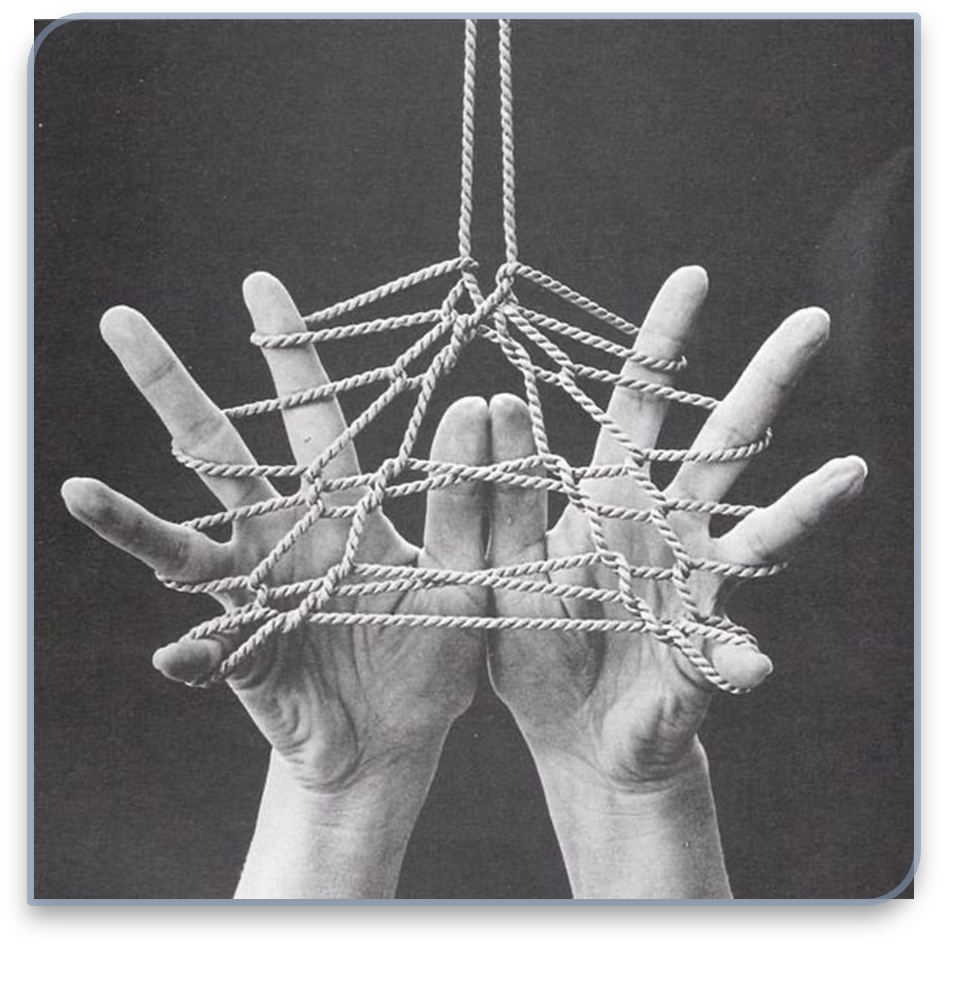
These six contiguous sections are affiliated rather than forming sequential sections or categories that form a manifesto. Each of these affiliated sections is related to the others in a network or cat’s cradle—to use the term that Haraway employs.(75) They are entangled or linked in a complicated structure. Put succinctly, Haraway aimed “to story the world otherwise”(76) in “Cyborg Manifesto,” and in doing so, demanded a different kind of methodology.
Haraway’s methodology in the “Cyborg Manifesto” may be seen as a form of creative ethnography.(77) Traditional ethnography prior to the 1970s tended to marginalize the experience of women in research.(78) This is indicative of the public/private dichotomy—the theoretical underpinning of liberalism and neo-liberalism—that operated to obscure and legitimate men’s dominance of women. In other words, it is symptomatic of asking, “who counts?” in society. Women’s lives, however, became increasingly important in ethnographic research and other qualitative methodologies after researchers began to heed the feminist call to describe women’s lived experience in their own words.(79) As a result, the question of whether there is a distinct feminist method of inquiry that traditional methodology has overlooked became problematic. How does one “add women” to existing analyses when it should have been done all along?(80) Dorothy Smith,(81) Patricia Hill Collins,(82) Sandra Harding(83) and others extended and reframed the notion of Marx’s standpoint of the proletariat as a remedy to adding women into existing research methodologies.
Haraway recognized the gains made by the development of feminist standpoint theory, but at the same time recognized what she referred to as “the god-trick of seeing everything from nowhere.”(84) In other words, she saw feminist approaches as potentially falling into the trap of essentialism. Her methodological approach is plural;(85) moreover, we can also see strains of proto-intersectionality in Haraway’s methodology.
The conventional methods—techniques—considered to be the root of ethnography are participant observation, interviewing, and analysis of the collected material.(86) Haraway, however, breaks boundaries and opts instead to use the experimental method of cyborg storytelling. Here, she also transgresses conventional methodological approaches. Storytelling is often used to teach ethics, values, and cultural norms.(87) However, in looking beyond Eurocentric knowledge systems and drawing on Indigenous peoples’ traditions, storytelling is not only a focus of Indigenous epistemologies but also a vital research paradigm.(88) Despite the work of many Indigenous scholars, Indigenous ideology is misrepresented and appropriated in academia—it flows in a “one-directional” manner across disciplines without acknowledgment of the original sources of stories and concepts.(89) In fact, feminism as a concept itself may also need to acknowledge the role that Indigenous women played in its shaping.(90)
Therefore, if, as I have previously stated, Haraway’s methodological approach is plural, we also need to consider that cyborg storytelling is bi-directional in nature and requires not only attribution, but also acknowledgment that the concept is a distilled version of Indigenous traditions.(91) Further substantiating this point is Haraway’s use of the cat’s cradle analogy in describing her framework. “Cat’s cradle” is a European version of the art of making pictures or telling stories using string and one’s hands as the following figure demonstrates:
Figure 1(92)
Haraway refocused feminist methodology with its ties to Indigenous traditions—albeit unacknowledged and distilled—to one based on affinities. This contributed to the methodological approaches being developed by cyberfeminists. In this way, the cyborg had a dual function as a core text of cyberfeminisms: first, in its form or metaphor; and secondly, in its function or methodology.
Thus far, this paper has concentrated mainly on Haraway’s positive contributions to cyberfeminisms, but the “Manifesto” has also been criticized, which leads to the question of whether this is in keeping with cyberfeminisms’ antinomies described earlier in this paper? Or whether these criticisms are effectively strains of a requiem for Haraway’s ironic myth?
Haraway’s metaphor of the cyborg has been criticized as lacking in “realism about the fate for ‘real’ women and men,”(96) when in fact, cyborg-thinking results in “[o]nce again the coloniser coloni[zing].”(97) In other words, the digital environment simply mirrors the oppressive behaviours that exist in the physical environment. Correspondingly, others contend that the metaphor is limited since the “cyborg itself is fraught with a Western, patriarchal violence that cannot be ignored in the greater context of technology and technological innovation.”(98) Others have maintained that the cyborg has become “literalized” in the hands of other academics and, as a result, has lost its function as a metaphor.(99)
The most powerful critiques and shortcomings identified concern the conflation of identity, thus raising the question as to whether we can continue to rely on Haraway. She claims, “we are all cyborgs.” But who is we? Sandoval and activists like Jillian Weise raise this fundamental question. Sandoval explains:
Haraway’s model has acted as a transcoding device, a technology that insists on translating the fundamental precepts of U.S. third world feminist criticism into categories that are comprehensible under the jurisdictions of feminist and cultural studies.(100)
It is not an accident that Haraway employs what Sandoval refers to as “U.S. third world feminism”—here we could also draw on the distillation of Indigenous methodology discussed earlier. Haraway weaves “affinity-through-difference” to advance her ironic cyborg feminist thinking, instead of giving it its theoretical and methodological due recognition. She conflates actual lived experience with generalized thinking about racialized women, thus depoliticizing and repressing the gains made. Equally, Weise explains:
[the “Manifesto”] coopts cyborg identity while eliminating reference to disabled people on which the notion of the cyborg is premised. Disabled people who use tech to live are cyborgs. Our lives are not metaphors.(101)
Again, who is we? Without acknowledging these shortcomings, we run the risk of repeating them.
Additionally, a weighty burden to the cyborg’s continued salience is Haraway’s own admission that the “Manifesto” had a “surprising half-life. It has proved impossible to rewrite the cyborg.”(102) However, in a later publication, Haraway reformulated the cyborg in the following way:
Cyborgs are kin, whelped in the litter of post-World War II information technologies and globalized digital bodies, politics, and cultures of hum and not-human sorts. Cyborgs are not machines in just any sense, nor are they machine-organism hybrids. In fact, they are not hybrids at all. They are, rather, imploded entities, dense material semiotic “things”— articulated string figures of ontologically heterogeneous, historically situated, materially rich, virally proliferating relatings of particular sorts, not all the time everywhere, but here, there, and in between, with consequences.(103)
What this points to is that while the cyborg was situated at a particular time in history and politics, the very nature of it was malleable. The fact and manner of affinities is that they are relational.(104) The cyborg as either method or methodology was not intended as totalizing or universal. The cyborg as a metaphor was never described as static, and the cyborg as methodology was creative and disrupted convention.
Haraway has also suggested we should keep “pushing it and filling it”(105) and that “cyborg figurations can continue to do critical work.”(106) These figurations include both discords and concords. The criticisms of “Cyborg Manifesto” may be considered apropos—they are in keeping with the antinomies of cyberfeminisms. But to continue being useful, cyborg figurations also need a “reboot.” Specifically, to continue relying on Haraway’s “Cyborg Manifesto,” we need to start again and fix the cyborg’s processing problems—not delete or “rewrite,”(107) but attribute and acknowledge as necessary. This is because cyberfeminisms are still relevant as we grapple with our increasingly digitally mediated lives, which the next section of this paper will deal with.
The division between the online and offline environment is rapidly merging, resulting in what may be described by the neologism, “onlife.” Hildebrandt explains:
To examine the continued salience of Haraway’s cyborg figurations, it is helpful to visualize the onlife environment. If we think about what the physical world looked like in layers prior to the Internet, it is fairly simple: a layer of people and things atop geography.[o]ur current life world can no longer be described by dichotomizing online and offline…Onlife singles out the fact that our ‘real’ life is neither on- nor offline, but partakes in a new kind of world that we are still discovering.(108)
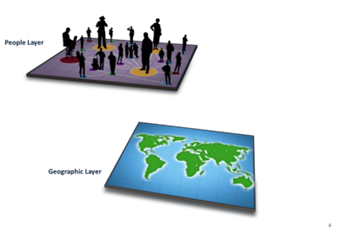
Figure 2(109)
This model also reveals hierarchy—people on land. And people and their relationship with land is deeply rooted in colonial land ownership. The development of ownership is replete with conquering, holding, and extracting discourses.(110)
In the digital paradigm, the geography and the people and things layers—and their histories—become “bookends”(111) of three additional layers: infrastructure, code, and devices.

Figure 3(112)
Adding extra layers to a model that was already problematic results in a furthering of existing problems. The onlife environment is not a fresh start. It is not “uptopian.”
We could say that the additional infrastructure layer merges with the geography base since it arguably remaps how we have traditionally understood jurisdictions, making it more complicated. And there is further complexity in this environment, not only because of added and merging layers, but because this environment results in new issues in respect of equity such as the digital divide, which may be described as the disparity between those who have reliable internet access and those who do not.(113)
Statistics show, for example, that there is a widening digital gender divide, specifically in developing countries: 48 per cent of women globally use the Internet on a daily basis, as opposed to 58 per cent of men.(114) This gap closes in the Americas, where it is at near parity.(115) There is also a racial disparity.(116) And there is age disproportion.(117)
How are cyborg figurations relevant in the re-mapped jurisdiction layer of the onlife environment? Haraway’s cyborg was a corrective though we know it was not without its shortcomings. Cyborg figurations are semblances of the simpler cyborg, but they are a mixture of discords and concords. This rebooted version—cyborg figurations—demands inclusivity, which involves equal access to opportunities and resources. In the onlife environment, historically marginalized individuals need not be re-marginalized.
In the device layer (in Figure 3) the people and things layers mingle together. Like the remapping of jurisdiction, this poses further complications. The two layers of people and devices are blurred or hybrid. We could, in fact, label this blurred layer as “the cyborg figuration layer.”
The code layer is the only distinct layer. And much has been said about it: from code is law(118) to law is code(119) and beyond to code is capital.(120) This layer does much more than instruct the computer what to do. Ripple effects in the code layer, result in ripple effects in the cyborg figuration layer, and in the re-mapped jurisdiction layer.
Taken altogether, these layers form the onlife environment. It is a much more complicated environment than the simpler people and geography model (Figure 2). The layers blur and combine. It is a compound model, rather than simple model. We can see from this visualization that the onlife environment is more complex. Drawing on the cat’s cradle analogy, issues such as technology-facilitated gender-based violence arise in networked ways. For instance, designs of ride-hailing platforms such as Uber facilitate sexual violence and intersect with other platforms that further the violence, such as Snapchat.(121)
The role of technology in facilitating sexual violence heightens what the United Nations has described as a global emergency of gender-based violence.(122) Eighty-five per cent of women have either experienced or witnessed online violence, with younger women facing an increased risk.(123) This statistic only increases when broadening the definition of gendered harms from solely cis-women to include both cis- and transgender women and girls, and those who hold intersecting marginalized gender identities. This points to a renewed urgency for cyberfeminisms. Further, the intersecting and networked nature of technology-facilitated gender-based violence demands that we think about affiliated approaches. Hashtag activism such as #MeToo is an example. Here, again, we see the salience of cyborg figurations.
The onlife environment creates issues that are transnational, interconnected, and networked. And courts are beginning to recognize the impact of this new and challenging environment. Take, for example, the 2017 Supreme Court of Canada decision in Douez v. Facebook,(124) in which the Court ruled that a forum selection clause found within Facebook’s terms of service was unenforceable when applied to a claim for breach of privacy legislation(125) in British Columbia. In its majority ruling, the Court found:
unlike a standard retail transaction, there are few comparable alternatives to Facebook, a social networking platform with extensive reach. British Columbians who wish to participate in the many online communities that interact through Facebook must accept that company’s terms or choose not to participate in its ubiquitous social network… Having the choice to remain “offline” may not be a real choice in the Internet era. (para. 56)Strictly speaking, reducing online activity is not a solution to dealing with onlife issues as it deprives individuals from fully participating in contemporary life.(126)
But at the same time as these new and networked problems arise, the solutions to them must also be affiliated. There is no universal solution to tackle the myriad of legal problems that are evolving in the onlife environment.
This investigation into the salience of Donna Haraway’s “Cyborg Manifesto” tells us that a modified version of the cyborg as a metaphor and a methodology continues to be relevant today, particularly as our online and offline lives merge. But in order not to replicate the mistakes of the past, the cyborg needs a reboot. By acknowledging its methodological sources— Indigenous ideology and practices—and by cultivating more inclusive identity, cyborg figurations hold the possibility of once again contributing to the tradition of “seizing the tools to mark the world that marked them as other.”(127)
In closing, since it seems that practically everyone who writes a paper about Haraway’s “Cyborg Manifesto” engages with its final line that states, “[t]hough they are bound in the spiral dance, I would rather be a cyborg than a goddess,” I will offer a rephrasing that avoids setting up dualisms and is potentially fit for our evolving onlife experience: Though they are bound in a spiral dance, I would rather think about cyborg figurations than all-knowing authority.
What does this analysis bring to the question of why it is that feminist legal scholarship has developed no feminist canon for us to inherit while we continue to revere the work of white male philosophers?
Some would argue that indeed there is a “canon” of classical feminist legal literature; for instance, MacKinnon, Hill Collins, etc. Another way of addressing this question is not to look to a canon, or an imaginary list, but to draw on cyborg figurations and take heed of affiliations—to look for networks and see relevance “on the ground.”
The term “canon” has its roots in the Greek word “kanon,” signifing a measuring rod or rule, and was extended to mean a list or catalogue, particularly in its application to the list of books in the Bible, which church authorities determined to be genuine Holy Scriptures.(128) The term subsequently became used in a secular manner to signify lists of works by particular authors—for instance, the Shakespeare canon, the Milton canon and so forth. The canon is connected to hierarchies and authority. More recently, as Abrams explains:
the phrase literary canon has come to designate…those authors who, by a cumulative consensus of critics, scholars, and teachers, have come to be widely recognized as “major,” and to have written works often hailed as literary classics.(129)
From the literary canon perspective, Harold Bloom—the great canon defender—argued “that aesthetic choice has always guided every secular aspect of canon formation.”(130) He believed that the canon was based on the strength of a work and that current “cheerleaders” could not open it. The problem with Bloom was that he set up binary oppositions—good and bad—and we know that this can draw us into reductive reasoning. Further, Haraway’s cyborg figurations demonstrated that dualisms are not helpful.(131)
In the context of law, certainly there are “canonical” or core texts that we cannot avoid. For instance, if you want to teach criminal law, you are going to have to study and teach the criminal code. One alternative to canon formation, however, is to think about Haraway’s “cat’s cradle” analogy, with appropriate attribution—to think about the connections, affiliations, and nodes. Perhaps what I am suggesting is that thinking about “canons” is not helpful—they are oppressive and exclusionary. Or in Haraway’s words, “the production of universal, totalizing theory is a major mistake that misses most of reality.”(132) One could say that canon-formation is decidedly anti-cyberfeminist.
What would an alternative, affiliated approach look like? One option would entail recognizing who is teaching the material in law school syllabi.(133) How many other cyberfeminisms courses are being taught nationally or internationally? We could conduct empirical research to find out relevant statistics. How many feminist tech law conferences occur around the world each year? How often is Haraway’s “Cyborg Manifesto” featured at those conferences? How frequently is it cited in academic papers annually? These are all affiliations in a network of feminisms. There is no need for an “imaginary” list.
* Lecturer in Law, Te Piringa Faculty of Law, University of Waikato, New Zealand. Email amanda.turnbull@waikato.ac.nz. The author would like to thank Professor Maria Drakopolou and Professor Rosemary Hunter, organizers of the Forgotten Foundations of Feminist Legal Scholarship Workshops (Kent Centre for Critical Thought, University of Kent), and Professor Jane Bailey (Faculty of Law, University of Ottawa).
(1) The Sphinx, a female monster with the body of a cat, wings of a bird, and an infinite source of riddles, devoured anyone who could not answer her riddles. She appears in Sophocles’ tragedy Oedipus Rex (Folkways Records, 1960).
(2) Lamia was a shapeshifter with the upper body of a woman and the lower half of a snake, who stole children and ate them. She appeared in Aristophanes’ comedy Peace. See Aristophanes, “Peace” in Eugene O’Neil, Jr, ed, The Complete Greek Drama, vol 2 (New York: Random House, 1938).
(3) Donna J. Haraway, “A Cyborg Manifesto” in Donna J. Haraway & Cary Wolfe, eds, Manifestly Haraway (Minneapolis: University of Minnesota Press, 2016) 3 at 55.
(4) Ibid at 7.
(5) Mary Flanagan & Austin Booth, “Introduction” in Mary Flanagan & Austin Booth, eds, Reload: Rethinking Women + Cyberculture (Cambridge, MA: MIT Press, 2002) at 11.
(6) Nicholas Gane & Donna Haraway, “When We Have Never Been Human, What Is to Be Done? An Interview with Donna Haraway” (2006) Theory, Culture and Society 135 at 150.
(7) The “Manifesto” grew out of a conference paper that Haraway wrote in 1983. See Donna Haraway, “New Machines, New Bodies, New Communities: Political Dilemmas of a Cyborg Feminist” (Paper delivered at “The Scholar and the Feminist X: The Question of Technology” Conference, Barnard College, April 1983, quoted in Stephen Whittle & Susan Stryker, The Transgender Studies Reader (Hoboken, NJ: Taylor & Francis, 2013) at 116 (n. 1); the conference paper reappeared significantly revised in form and in title as “A Cyborg Manifesto”—a tacit reference to its predecessor, “The Communist Manifesto”—two years later the Socialist Review (1985).
(8) N. Katherine Hales, “Unfinished Work: From Cyborg to Cognisphere” (2006) 23 Theory, Culture & Society 159 at 159.
(9) See N. Katherine Hayles, How We Became Post-Human: Virtual Bodies in Cybernetics, Literature, and Informatics (Chicago: University of Chicago Press, 1999); Hales, “Unfinished Work,” ibid; Stephanie Peebles Tavera, “Utopia, Inc.: A Manifesto for the Cyborg Corporation” (2017) 44:1 Science Fiction Studies 21. The cyborg has been also “reassessed as an ethical concept” within an Irigarian ethical framework rather than as a political or ontological issue. And in developing an ethics, Haraway’s cyborg writing may be seen as “a contemporary écriture feminine.” See Margaret E. Toye, “Donna Haraway’s Cyborg Touching (Up/On) Luce Irigaray’s Ethics and the Interval Between Poethics as Embodied Writing” (2012) 27:1 Hypatia 182 at 185; see also Annie Goh & Marie Thompson, “Sonic Cyberfeminisms: Introduction” (2021) 127 Feminist Rev 1.
(10) Sandoval saw problems regarding the universalizing of the figure of the cyborg and issues of appropriation: Chela Sandoval, “Cyborg Feminism and the Methodology of the Oppressed” in Chris Gray, ed, The Cyborg Handbook (New York: Routledge, 1995). See also Sheryl Hamilton, “The Cyborg, 11 Years Later: The Not-So-Surprising Half-Life of the Cyborg Manifesto” (1997) 3:2 Convergence 104; Anne Balsamo, “Feminism for the Incurably Informed” (1993) 92:4 The South Atlantic Quarterly 681.
(11) See Renate Klein, “If I’m a Cyborg and Not a Goddess Will Patriarchy Go Away?” in Susan Hawthorne & Renate Klein, eds, Cyberfeminism: Connectivity, Critique and Creativity (Melbourne: Spinifex Press, 1999) 185; Jenny Sundén, “What Happened to Difference in Cyberspace? The (Re)turn of the She-borg” (2001) 1 Feminist Media Studies 215; Malini Johar Schueller, “Analogy and (White) Feminist Theory: Thinking Race and the Color of the Cyborg Body” (2005) 31 Signs: Journal of Women in Culture and Society 63; Julie R DeCook, “A [White] Cyborg’s Manifesto: The Overwhelmingly Western Ideology Driving Technofeminist Theory” (2021) 43:6 Media, Culture & Society 1158.
(12) Joseph Schneider, “Conversations with Donna Haraway” (Interview by Joseph Schneider) in Donna Haraway: Live Theory (New York: Continuum, 2005) at 58.
(13) David Bell, Cyberculture Theorists: Manuel Castells and Donna Haraway, 1st ed (London: Routledge, 2006) at 97.
(14) Zoë Sofoulis, “Cyberquake: Haraway’s Manifesto” in Darren Tofts, Annemarie Jonson & Alessio Cavallaro, eds, Prefiguring Cyberculture: An Intellectual History (Cambridge, MA: MIT Press, 2002) 84 at 97.
(15) Sadie Plant, Zeroes and Ones (London: Fourth Estate, 1997). Note that VNS (pronounced Venus) Matrix, an Australian women-artist collective whose media installations rebelliously probed patriarchal discourses of domination and control, also used the term in describing their own “Cyberfeminist Manifesto for the Twenty-First Century:” see Faith Wilding, “Notes on the Political Condition of Cyberfeminism” (1998) 57:2 Art J 47.
(16) Cyberspace may be defined as “informational data space made available by electrical circuits and computer networks:” see Victor Vitanza, Cyberreader (Boston: Allyn and Bacon, 1999) at 5.
(17) Flanagan & Booth, supra note 5at 12.
(18) During “The First Cyberfeminist International,” a meeting that took place in 1997 at the tenth edition of the contemporary art exhibition “Documenta,” an international coalition of cyberfeminists entitled, “Old Boys Network,” agreed to keep the term undefined. See “First Cyberfeminist International” (Conference proceedings, 2028 September 1997), monoskop.org/images/7/77/First_Cyberfeminist_International_1998.pdf.
(19) See Sandoval, supra note 10.
(20) See Maria Fernandez, Faith Wilding & Michelle M. Wright, eds, Domain Errors! Cyberfeminist Practices (Williamsburg: Autonomedia, 2003) at 22-23.
(21) See Flanagan & Booth, supra note 5 at 12.
(22) Trevor Scott Milford, “Revisiting Cyberfeminism: Theory as a Tool for Understanding Young Women’s Experiences” in Jane Bailey & Valerie Steeves, eds, eGirls, eCitizens (Ottawa: University of Ottawa Press, 2015) 55 at 57.
(23) See Susan Hawthorne & Renate Klein, “Introduction” in Susan Hawthorne & Renate Klein eds, Cyberfeminism: Connectivity, Critique and Creativity (Melbourne: Spinifex Press, 1999) at 1.
(24) Ibid.
(25) Jane Bailey & Adrienne Telford, “What’s So ‘Cyber’ About It?: Reflections on Cyberfeminism’s Contribution to Legal Studies” (2007) 19:2 Can J of Women and the Law 243 at 244.
(26) See e.g. Ilan Gur-Ze’ev, “Cyberfeminism and Education in the Era of the Exile of Spirit” in Ilan Gur-Ze’ev, ed, Beyond the Modern-Postmodern Struggle in Education (Boston: Brill, 2007) at 185.
(27) See e.g. Maura McAdam, Caren Crowley & Richard T. Harrison, “Digital Girl: Cyberfeminism and the Emancipatory Potential of Digital Entrepreneurship in Emerging Economies” (2020) Small Business Economics 349.
(28) See e.g. Mary Flanagan & Suyin Looui, “Rethinking the F Word: A Review of Activist Art on the Internet” (2007) 19:1 National Women’s Studies Association J 181.
(29) See e.g. Shahrzad Mojab, “The Politics of ‘Cyberfeminism’ in the Middle East: The Case of Kurdish Women” (2001) 8:4 Race, Gender & Class 42.
(30) See e.g. Bailey & Telford, supra note 25; see also Bela Bonita Chatterjee, “Razorgirls and Cyberdykes: Tracing Cyberfeminism and Thoughts on Its Use in a Legal Context” (2002) 7 International J of Sexuality and Gender Studies 197.
(31) Technology-facilitated gender-based violence is an evolving issue wherein technology functions as a means of perpetuating and amplifying existing forms of gender-based violence. This form of violence is a metamorphosis of the offline intersecting systems of oppression in society, including sexism, racism, colonialism, ableism, transphobia, and homophobia. See Cynthia Khoo, ‘‘Deplatforming Misogyny: Report on Platform Liability for Technology-Facilitated Gender-Based Violence”, Women’s Legal Education & Action Fund (2021), www.leaf.ca/publication/deplatforming-misogyny/.
(32) Patricia Smith refers to the reflection that law offers as “not an ordinary mirror. It’s a magic mirror, always reflecting a vision that is slightly in the past. It is only able to reflect reality if it moves slowly. Feminist jurisprudence is about correcting the current lag:” “Feminist Jurisprudence and the Nature of Law”, from “Feminist Jurisprudence” in Keith Culver & Michael Giudice, eds, Readings in the Philosophy of Law, 3rd ed. (Peterborough: Broadview Press, 2017) 218-227 at 227.
(33) See e.g. Mary Joe Frug, Postmodern Legal Feminism (New York: Routledge, 1993); see also Patricia J. Williams, The Alchemy of Race and Rights: Diary of A Law Professor (Cambridge, MA: Harvard University Press, 1992).
(34) “Cyborg,” DC Comics, www.dc.com/characters/cyborg.
(35) See generally Douglas Coupland, “The Ghose of Invention: A Visit to Bell Labs,” Wired,
interactive.wired.com/www-wired-com__2014__09__coupland-bell-labs/index.html#ch-1.
(36) See Manfred E. Cynes & Nathan S. Kline, “Cyborgs and Space” (1960) 5:9 Astronautics; see also Alexis C. Madrigal, “The Man Who First Said ‘Cyborg’ 50 Years Later,” The Atlantic (30 September 2010), www.theatlantic.com/technology/archive/2010/09/the-man-who-first-said-cyborg-50-years-later/63821/.
(37) See Norbert Wiener, Cybernetics: Or, Control and Communication in the Animal and the Machine (New York: Wiley & Sons, 1948).
(38) Donna Haraway & Nada Miljkovic, “The Best Possible Now” in Chris Hables Gray, Heidi Figueroa-Sarriera & Steven Mentor, eds, Modified: Living as a Cyborg (New York: Routledge, 2020) 282 at 283.
(39) Jess Zimmerman, Women and Other Monsters: Building a New Mythology (Boston: Beacon Press, 2021) at 7.
(40) In Greek mythology, Medusa was one of three monstrous sisters, known for having had hair made of snakes and the ability to turn anyone who looked at her into stone.
(41) In Homer’s Odyssey, Odysseus must choose between fighting Scylla, a six-headed barking creature and Charybdis, a sea monster of doom. Both were described as female. See Homer, The Odyssey (New York: G.P. Putnam’s Sons, 1919).
(42) Chimera was a fire-breathing monster of many disparate parts (lion, goat and dragon). See Homer, The Iliad, Robert Fagles trans. (Toronto: Penguin Books, 1998).
(43) Mary Shelley, Frankenstein: Or, the Modern Prometheus (Toronto: Penguin Books, 2003).
(44) Haraway & Miljkovic, supra note 38 at 282.
(45) Haraway, supra note 3 at 150.
(46) Ibid at 5.
(47) Note this is a “catch all” label. Indigenous peoples call tricksters by their own names such as Nanabush or Nanbozho (Anishanaabe), Glooscap (Algonquin), Wisakedjak (Cree) and Raven (Northwest Coast Indigenous peoples). See e.g. John Borrows, “Hereos, Tricksters, Monsters, and Caretakers: Indigenous Law and Legal Education (2016) 61:4 McGill L J 795.
(48) Ibid.
(49) See John Borrows, Law’s Indigenous Ethics (Toronto: University of Toronto Press, 2019).
(50) Haraway, supra note 3 at 7.
(51) Ibid.
(52) Dr. Robert Jarvik is known for his work on the first permanent artificial heart that was successfully transplanted into a patient in 1982. See Sanna Khan & Waqas Jehangir, “Evolution of Artificial Hearts: An Overview and History” (2014) 5:5 Cardiology Research 121.
(53) See e.g. Lois M Plunkert, “The 1980s: A Decade of Job Growth and Industry Shifts” (1990) Monthly Labor Rev, www.bls.gov/opub/mlr/1990/09/Art1full.pdf.
(54) The program was abandoned a decade after it was initiated. See e.g. William A. Schwartz & Charles Derber et al., The Nuclear Seduction: Why the Arms Race Doesn’t Matter—and What Does (Oakland: University of California Press, 1990).
(55) Haraway, supra note 3 at 154.
(56) Ibid at 150.
(57) Ibid at 160.
(58) Ibid at 141; see also Bailey & Telford, supra note 25 at 256 (“MacKinnon’s approach ‘theorizes away’ women’s individual agency by defining ‘woman’ as a subject that depends for its existence of being the sex object of man”).
(59) See Audre Lorde, Sister Outsider (Freedom, CA: Crossing Press, 1984).
(60) Bailey & Telford, supra note 25 at 255.
(61) See e.g. Denise Dijk, “The Goddess Movement in the USA: A Religion for Women Only” (1988) 18:1 Psychology of Religion 258.
(62) Donna Haraway, The Haraway Reader (New York: Routledge, 2004) at 3.
(63) Hamilton, supra note 10 at 104.
(64) Nils J. Nilsson, The Quest for Artificial Intelligence: A History of Ideas and Achievements (Cambridge:
Cambridge University Press, 2010) at 46.
(65) See e.g. Ursula K. Le Guin, The Dispossessed (New York: Harper & Row, 1974).
(66) Margaret Atwood, “Dire Cartographies: The Roads to Ustopia” in In Other Worlds: SF and the Human Imagination (Knopf Doubleday, 2011) at 85.
(67) See e.g. Susan A. Bandes et al., Research Handbook on Law and Emotion (Northampton, MA: Edward Elgar, 2021).
(68) Haraway, supra note 3 at 151.
(69) Ibid.
(70) Ibid at 152.
(71) Ibid at 181.
(72) See Barry Leiner et al., “Brief History of the Internet,” Internet Society (1997) www.internetsociety.org/internet/history-internet/brief-history-internet/.
(73) Richard Gordon, “The Computerization of Daily Life, the Sexual Division of Labor, and the Homework Economy” (Paper delivered at the Silicon Valley Workshop Conference, University of California, Santa Cruz, 1983).
(74) Donna Haraway, “A Game of Cat’s Cradle: Science Studies, Feminist Theory, Cultural Studies” in Arthur Kroker & Marilouise Kroker, eds, Critical Digital Studies: A Reader, 2nd ed (Toronto: University of Toronto Press, 2013) 59.
(75) Ibid.
(76) Bell, supra note 13at 107.
(77) See e.g. Denielle Elliott & Dara Culhane, A Different Kind of Ethnography: Imaginative Practices and Creative Methodologies (Toronto: University of Toronto Press, 2017).
(78) See Nancy A. Naples, Feminism and Method: Ethnography, Discourse Analysis, and Activist Research (New York: Routledge, 2003) at 7.
(79) Ibid at 7-8.
(80) Sandra Harding, ed, Feminism and Methodology (Bloomington: Indiana University Press, 1988) at 1.
(81) Dorothy Smith, Institutional Ethnography: A Sociology for People (Lanham: AltaMira Press, 2005).
(82) Patricia Hill Collins, Black Feminist Thought: Knowledge, Consciousness and the Politics of Empowerment (New York: Routledge, 1990).
(83) Harding, supra note 80.
(84) Haraway, supra note 3 at 189.
(85) Naples develops what she refers to as a “multidimensional feminist standpoint approach to ethnography.” See Naples, supra note 78 at 8.
(86) Elliot & Culhane, supra note 77at 9.
(87) Cover explains the connection between narratives and law in Robert Cover, “Nomos and Narrative” (1983) 97:4 Harvard L Rev 3 at 3-4; see also John Borrows, Recovering Canada: The Resurgence of Indigenous Law (Toronto: University of Toronto Press, 2002) at 14.
(88) See e.g. Eun-Ji Amy Kim & Sandra-Lynn Leclaire, “‘To See Together Without Claiming to be Another’: Stories as Relations, Against One-Directional Move of Indigenous Stories Travelling” (2021) 7:1 Engaged Scholar Journal: Community-Engaged Research, Teaching, and Learning 86,
esj.usask.ca/index.php/esj/article/view/70002/54237. The title is a direct quote from Donna Haraway, “Situated
Knowledge: The Science Question in Feminism and the Privilege of Partial Perspective” (1988) 14:3 Feminist Studies 575. The authors critically review and reflect on the theories and practices in conventional academia that produce a “one directional” move of storytelling as a practice and a theory without seeking original approval from Indigenous communities. Of particular relevance in Kim & Leclaire is the following statement: “[s]ettler colonialism coupled with neoliberal capitalist values embedded in academia result in academic practice and cultures that reproduce the perpetuation of a one-directional move of Indigenous story travelling” at 90; see also Judy Iseke, “Indigenous Storytelling as Research” (2013) 6:4 International Rev of Qualitative Research 559.
(89) Kim & Leclaire, ibid at 91.
(90) Gilio-Whitaker states, “The imposition of foreign cultures, and Christianity in particular, was corrosive to societies that were typically matrilineal or matrifocal, were foundationally equitable in the distribution of power between genders, and often respected the existence of a third gender and non-hetero relationships.” See Dina GilioWhitaker, “The Indigenous Roots of Modern Feminism” (11 March 2020), www.beaconbroadside.com/broadside/2020/03/the-indigenous-roots-of-modern-feminism.html; see also Robert A. Williams Jr, The American Indian in Western Legal Thought: The Discourses of Conquest (Oxford: Oxford University Press, 1990).
(91) Kim & Leclaire supra note 88 at 95.
(92) From “Cat's Cradles, And Other String Figures” (Penguin, First UK Edition, 22 Nov. 1979), www.catscradlecollective.com.
(93) See “String Games”, University of Regina,aboriginalperspectives.uregina.ca/games/game14.shtml.
(94) Haraway refers to irony as “blasphemy:” supra note 3 at 5.
(95) The concept of deterritorialization is concerned with subverting formal structures—or territorial groupings—such as the church, the family, or any socially arranged aggregate. Deterritorialization involves the indelible potential to change and mutate from within. See Gilles Deleuze, L’Anti-Oedipus: Capitalism and Schizophrenia (Paris: Éditions de Minut, 1972).
(96) Klein also notes: “who will it be that decides who—of which country, sex, race, age—will get the latest electronically wired body, and who will miss out?” See Klein, supra note 11 at 201.
(97) Hawthorne & Klein, supra note 23 at 217.
(98) DeCook, supra note 11 at 1158.
(99) See Ingrid Bartsch, Carolyn DiPalma & Laura Sells, “Witnessing the Postmodern Jeremiad: (Mis)Understanding Donna Haraway’s Method of Inquiry” (2001) 9:1 Configurations 127 at 140.
(100) Chela Sandoval, “New Sciences: Cyberfeminism and the Methodology of the Oppressed” in David Bell & Barabara M. Kennedy, The Cybercultures Reader (New York: Routledge, 2000) 374.
(101) Jillian Weise, “Common Cyborg”, Granta, granta.com/common-cyborg.
(102) Donna Haraway, “Introduction” to “A Manifesto for Cyborgs: Science, Technology, and Socialist Feminism in the 1980s” in Elizabeth Weed, ed, Coming to Terms: Feminism, Theory, Politics (New York: Routledge, 1989) at 173.
(103) Donna Haraway, Staying With the Trouble: Making Kin in the Chthulucene (Durham, NC: Duke University Press, 2016) at 104.
(104) See Jennifer Nedelsky, Law’s Relations: A Relational Theory of Self, Autonomy, and Law (New York: Oxford University Press, 2012).
(105) Donna Haraway & Thyrza Goodeve, How Like a Leaf (New York: Routledge, 1998) at 36.
(106) “Interview with Donna Haraway” in Don Ihde and Evan Selinger, eds, Chasing Technoscience: Matrix for Materiality (Bloomington: Indiana University Press, 2003) at 52.
(107) Ibid.
(108) See Mireille Hildbrandt, Smart Technologies and the End(s) of Law: Novel Entanglements of Law and Technology (Northampton, MA: Elgar Publishing, 2015) at 42.
(109) C. Inglis, “Cyberspace—Making Some Sense of It All” (2016) 15:2 J of Information Warfare 17 at 19.
(110) See especially Williams, supra note 90.
(111) Inglis, supra note 109.
(112) Ibid at 23.
(113) See e.g. Jan Van Dijk, The Digital Divide (Cambridge: Polity Press, 2020); see also Anne Peacock, Human
Rights and the Digital Divide (London: Routledge, 2019).
(114) See International Telecommunications Union, Press Release, ‘‘New ITU data reveal growing Internet uptake but a widening digital gender divide” (5 November 2019) www.itu.int/en/mediacentre/Pages/2019PR19.aspx.
(115) Ibid.
(116) See Mark Barna, ‘‘Access to internet crucial during COVID-19 outbreak: Broadband connection considered social determinant of health” (September 2020) 50:7 The Nation’s Health thenationshealth.aphapublications.org/content/50/7/ 5.2.
(117) See United Nations, ‘‘Peace, dignity and equality on a healthy planet”,
web.archive.org/web/20201210181203/www.un.org/en/sections/issues-depth/ageing/.
(118) See Lawrence Lessig, Code and Other Laws of Cyberspace (New York: Basic Books, 1999); see also Lawrence Lessig, Code 2.0 (New York: Basic Books, 2008).
(119) The converse: laws of society ultimately shape the design of computer systems. See e.g. Daniel Castro, “Law is Code”, Centre for Data Innovation (13 February 2014)da, tainnovation.org/2014/02/law-is-code/.
(120) See Katharina Pistor, The Code of Capital: How the Law Creates Wealth and Inequality (Princeton: Princeton University Press, 2019).
(121) See Amanda Turnbull, “Onlife Harms: Uber and Sexual Violence” (2022) 19:2 Canada J of L & Technology.
(122) UN Women, “Gender-Based Violence: Women and Girls at Risk” (2021), www.unwomen.org/en/hqcomplex-page/covid-19-rebuilding-for-resilience/gender-based-violence.
(123) Ibid.
(124) Deborah Douez brought an action in British Columbia (BC) alleging that Facebook’s use of her name and image without consent violated the Privacy Act. She also sought to certify this action as a class proceeding to include all BC residents whose names and/or pictures were used by Facebook in the same manner. Facebook brought a preliminary motion to stay the action on the basis of its forum selection and choice of law clause. The forum selection clause, which is contained within Facebook’s terms of use at the point of registering a user, required that any disputes be resolved in California. Facebook’s motion was declined, and the class action was certified. The BC Court of Appeal reversed the decision, finding the forum selection clause enforceable. The SCC overruled the Court of Appeal’s decision in Douez in a majority ruling. It found that Douez had established strong cause not to enforce the forum selection on the basis of public policy considerations. See Douez v Facebook, Inc [2017] 1 SCR 751[Douez].
(125) Privacy Act (RSBC 1996, c 373).
(126) Note that the ruling in Douez has implications for what is known as the “false dichotomy,” i.e. the perception that there is a contrast between gender-based violence in the online and offline worlds. For more explanation on this, see Khoo, supra note 31. See more generally Suzie Dunn, “Is it Actually Violence? Framing Technology Facilitated Harms as Violence” in Asher Flynn, Nicola Henry & Jane Bailey, eds, Technology-Facilitated Violence & Abuse: International Perspectives and Experiences (Melbourne: Emerald Publishing, 2021) 25.
(127) Haraway, supra note 3.
(128) M.H. Abrams, A Glossary of Literary Terms, 7th ed (Boston: Heinle, 1999) at 28.
(129) Ibid at 29.
(130) Harold Bloom, The Western Canon: The Books and School of the Ages (Toronto: Penguin Books, 1994) at 21.
(131) Note Guillory sees that “[t]he canon is never other than an imaginary list; it never appears as a complete and uncontested list in any time and place.” See John Guillory, Cultural Capital: The Problem of Literary Canon Formation (Chicago: University of Chicago Press, 1993) at 30.
(131) Haraway, supra note 3 at 67.
(133) Guillory suggests this as an alternative to overthrowing the canon. See Guillory, supra note 131. Professor Jane Bailey (Faculty of Law, University of Ottawa), for instance, teaches a first year Cyberfeminism course (CML 1150) annually. Donna Haraway’s “Cyborg Manifesto” is on the syllabus as a “foundational” text of cyberfeminism.